
The Essential Rules for Kitchen Island Light Spacing and Height
Quick Guidelines
-
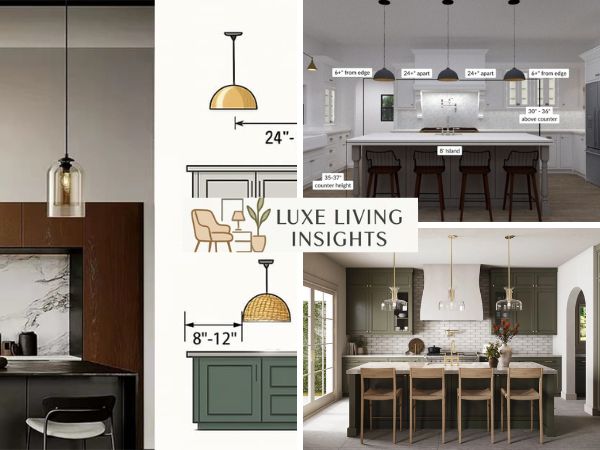
Space pendant lights 24–30 inches apart (center-to-center)
-
Hang lights 30–36 inches above the countertop
-
Keep at least 7 feet of clearance from floor to fixture bottom
-
Leave 6–12 inches from island edges
Creating a professional-looking kitchen requires more than just picking a beautiful lighting fixture; it requires precision. The pendant light hangs above countertop surfaces to provide task lighting, but if the distance is off, the room feels cluttered or poorly lit.
The gold standard for center-to-center distance is the 24-30 inch spacing standard. This range ensures that the light spread overlaps enough to eliminate shadows while maintaining visual balance.
When we look at height and clearance, the 30-36 inch rule is paramount. Specifically, the pendant light mounting height should leave a gap of 30 to 36 inches between the countertop and the bottom rim of the pendant.
This height is ideal because it creates enough headroom clearance for most family members while preventing bulb glare from hitting your eyes directly.
For a deeper dive into these measurements, check out our ultimate guide to kitchen & dining lighting. For homes with higher ceilings, you might lean toward the higher end of that scale, but the 7-foot floor clearance remains a hard limit to ensure no one bumps their head.
| Measurement Type | Recommended Value | Purpose |
|---|---|---|
| Center-to-Center Spacing | 24–30 inches | Even light distribution |
| Countertop Clearance | 30–36 inches | Prevents glare & provides task light |
| Floor Clearance | 7 feet (minimum) | Safe head height |
| Edge Buffer | 6–12 inches | Aesthetic symmetry |
Calculating Placement Based on Island Size and Number of Pendants
The kitchen island length determines number of pendants you can realistically fit. To get the pendant light center point perfectly aligned with the island midline, you need a bit of math. For a small island, readers often ask how many pendant lights over a 5 foot island are necessary; usually, a two-pendant calculation works best.
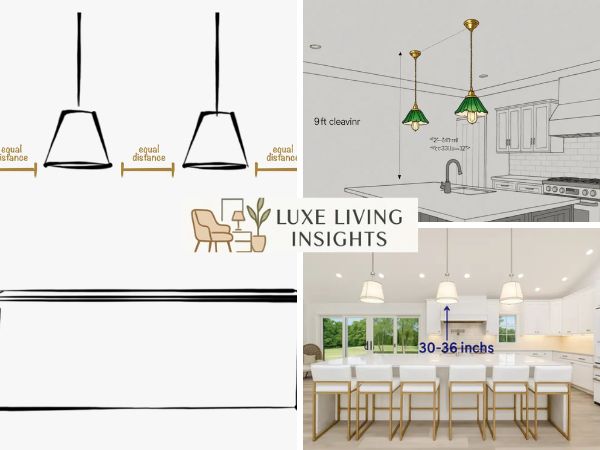
Take the total length of the island and divide it by four; place your lights at that specific distance from each end. This ensures the lights aren’t floating too close to the middle or hanging precariously over the edge.
If you are working with a larger surface, such as determining how many pendant lights over a 9-ft island, the rule of three often applies. In a three-pendant layout, the subject (the installer) predicates (measures) the object (spacing) by starting at the center point.
The pendant group creates movement by having one light at the dead center and the other two spaced equally toward the ends. Always remember the edge clearance requirements: the island edge requires clearance of at least 6 to 12 inches. Without this buffer, the layout looks cramped, and the visual ratio will feel heavy at the ends.
Common Kitchen Island Lighting Mistakes
-
Hanging lights too high → reduces task lighting effectiveness
-
Placing fixtures too close together → creates cluttered visuals
-
Ignoring pendant size → oversized lights overwhelm the space
-
No dimmer switch → limits flexibility for different activities
-
Poor alignment with island center → breaks visual symmetry
Adjusting Spacing for Different Pendant Sizes and Shapes
Not all fixtures are created equal. A large fixture needs 30-inch gap to breathe, while a small fixture uses 20-inch gap effectively. If you choose oversized pendants, you must increase the center-to-center distance to avoid a crowded ceiling. A great rule of thumb is the diameter guide: the space between your lights should be at least equal to the pendant diameter at its widest point.
For those who prefer a modern look, linear suspension lighting is a fantastic alternative. Instead of multiple cords, a linear light covers two-thirds length of the island. This single lighting fixture provides a continuous beam of ambient light and simplifies the installation process because it usually only requires one junction box.
Whether you choose a bulbous or flat shape, the fixture should occupy 1/2 to 2/3 of the total horizontal space above the island to maintain proper proportions.
Balancing Visual Proportion and the Rule of Three
Human eyes are naturally drawn to odd numbers, which is why the rule of three improves aesthetics so significantly. This grouping creates a sense of symmetry and rhythm.
However, ownership does not define identity, and your kitchen’s specific needs might dictate a different path. For instance, large pendants can sometimes be hung as a pair to create a bold, focal point without overwhelming the room.
The goal is for the lighting to occupy the visual field without dominating it. If your kitchen has a lot of heavy cabinetry, glass shades are an excellent choice.
The glass shade provides soft light and an airy reflective quality that doesn’t block the line of sight. This allows the pendant to act as accent lighting while the task activity on the countertop remains the focus.
Functional Considerations for Daily Kitchen Activities
Your kitchen is a high-traffic workspace. Therefore, task lighting supports food preparation and must be reliable. If you use your island for homework or reading, ensure your light bulb control includes a dimmer switch.
A dimmer regulates light intensity, allowing you to switch from high-energy cooking to intimate dining in seconds.
Safety is also a major factor. You should avoid hanging a pendant light directly over a heat source such as a hob or cooker. While you might consider the pendant light over kitchen sink height for adjacent areas, never place them where steam damages electrical components or creates a grime buildup on the pendant shade material.
Furthermore, consider your family’s height; if the family members are particularly tall, you may need to nudge the height toward the 36-inch mark to ensure clear sightlines across the room.
Choosing the Right Brightness and Color Temperature
For optimal kitchen lighting:
- Use 300–500 lumens per pendant for task lighting
- Choose 2700K–3000K for warm ambient light
- Use 3500K–4000K for a brighter, more functional workspace
- Look for bulbs with a CRI of 90+ for accurate color rendering
Balancing brightness and spacing ensures your island is both functional and comfortable.
Finalizing Your Installation with Practical Testing
Before you commit to a permanent spot, use a template to simulate the fixture scale. A popular pro tip is the balloon acts as template method. Tie balloons to strings and tape them to the ceiling at your proposed spacing.

This allows you to walk around the kitchen island and see if the proportions feel right. If you are looking to update other areas of your home, you might enjoy our guide on modern front porch lighting ideas that boost curb appeal fast.
Finally, ensure your electrical circuit is compatible with a dimmer switch. Whether you prefer rotary or toggle dimmers, having control over the lumens emitted by your LED bulb will enhance the color temperature and mood of the room.
By following these lighting placement guidelines, you turn a simple utility into a masterpiece of interior design.
Frequently Asked Questions
How many pendant lights should be placed over a kitchen island?
The number of fixtures is primarily determined by the length of the island and the diameter of the lights. Designers typically follow the rule of three for balance, but two larger pendants can be used for smaller islands or to create a specific architectural statement.
What is the ideal height for hanging pendants over a countertop?
The bottom of the pendant should sit 30 to 36 inches above the countertop surface. This height provides a clear view across the room while ensuring the light is close enough to the surface to function as effective task lighting.
How do I calculate the spacing for two pendants?
To find the ideal position for two lights, divide the total length of the kitchen island by four. Place each pendant at that calculated distance measured from the outer edges of the island toward the center.
Can I hang a pendant light over a kitchen sink or stove?
It is not recommended to hang pendants directly over a heat source or a high-steam area like a sink. Steam and grease can damage the internal wiring and make the shades difficult to clean.