
Achieving perfect dining room clearance spatial dynamics starts with the 3-foot rule. This guide explores how dining room walkway clearance and furniture layout planning create a functional pathway. By following interior design standards, you can transform your space into an area optimized for traffic flow and dining room ergonomics.

Understanding the 3-Foot Rule for Functional Dining Room Clearance
The 3-foot rule serves as the cornerstone of interior design standards. To ensure a functional pathway, a minimum clearance of 36 inches—or approximately 91 cm—is required between the table edge and the nearest wall or furniture.
This standard clearance is not a mere suggestion; it is a calculation of human movement. When an occupant pulls out dining chair units, they typically require 18–24 inches of space. Without the full 3-foot rule, the remaining area for traffic flow optimization disappears, leading to a cramped and frustrating environment.
A proper layout prevents crowding, which is essential for both comfort and accessibility. If your dining area serves as a main artery of the home, such as a path leading to the kitchen or living room, the high-traffic clearance should increase. In these high-traffic areas, designers recommend a distance of 42–48 inches.
This ensures that people can walk behind seated guests without requiring them to scoot their chairs inward. By maintaining these distances, the clearance prevents crowding and preserves the visual weight and spatial perception of the room.
Ultimately, a designer applies 3-foot rule principles to guarantee that guests have enough space to enjoy their meal without the distraction of bumped elbows or restricted movement. Choosing dining room tables that elevate your space is only the first half of the journey; placement is what completes the experience.
How to Calculate the Maximum Table Size for Your Room Dimensions
Determining the optimal seating capacity begins with the room size, which directly determines table dimensions. To find your ideal maximum table size, you should measure the room length and width and then subtract 6 feet from both dimensions.
This simple measurement guarantees comfort by automatically allocating 3 feet of clearance for each side of the table. For example, in a 12′ x 14′ room, the max table size should be 6′ x 8′ (or 72” x 96”). When browsing for stunning beautiful dining tables and chairs, keep these perimeter measurements in mind to avoid a cluttered look.
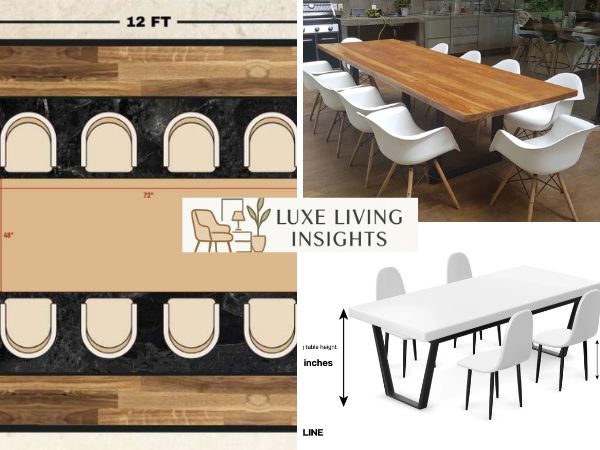
When performing these calculations, remember that furniture defines room function. You must account for close entities like a sideboard, china cabinet, or buffet. If a sideboard is placed against a wall, the 36-inch clearance must be measured from the edge of that furniture piece rather than the wall itself.
Accurate measurement avoids frustration during holiday gatherings when the room is at full capacity. By respecting the interior proportions, you ensure the floor plan remains open. This furniture layout planning stage is where visual weight is balanced, ensuring the dining table does not overwhelm the floor space.
Seating Capacity Standards: Balancing Elbow Room and Table Length
Every diner needs a dedicated amount of personal space to feel comfortable. The standard for individual seating suggests a table length of 24 inches per person.
This 24-inch length supports one diner, providing sufficient elbow room to eat without feeling restricted. Looking at dining room tables with style trending now can reveal how modern shapes fit your room flow while adhering to these standards.
- A 72-inch table (6 feet): Comfortably accommodates 6 people (2 on each side, 2 on each end).
- A 96-inch table (8 feet): Comfortably seats 8 people (3 on each side, 2 on each end).
- A 120-inch table (10 feet): Suitable for 10 people (4 on each side, 2 on each end).
However, the impact of dining chair width can alter these requirements. An average chair has a width of 18–22 inches. If you choose wide chairs or armchairs with a width of 22 inches or more, you must increase the per-person allowance to 28–30 inches.
Armchairs typically occupy the table ends, and because they are often the largest dining chair width items in the room, they require careful placement to avoid blocking the walkway. Proper planning ensures that guests need elbow room that is actually available, fostering a welcoming atmosphere and genuine connection.
Selecting Table Shapes and Bases to Optimize Traffic Flow
The table shape influences room movement and can drastically change the spatial perception of your dining room. Rectangular tables are a classic choice that fit narrow rooms perfectly.
Alternatively, oval tables offer a similar surface area but feature softened edges, which can improve flow in tight circulation paths. For square-shaped or smaller areas, round tables are often the best for small rooms because they eliminate sharp corners and facilitate easier social interaction.
Beyond shape, the table base plays a vital role in dining room ergonomics. A pedestal base or a trestle base is often superior to a traditional four-leg design because it provides more legroom. If you prefer unique dining tables to make your space truly spectacular, a pedestal design often creates more legroom.

Another critical measurement is the table apron. To maintain thigh space clearance, ensure there are at least 7 inches between the chair seat and the bottom of the apron. This attention to detail ensures that the household utilizes dining area spaces with maximum physical ease.
Space-Saving Strategies for Small or Multi-Functional Dining Areas
When floor space is at a premium, you must get creative with furniture layout planning. One of the most effective space-saving solutions is the dining bench. Unlike individual chairs, benches tuck under dining tables when they are not in use.
This action instantly clears the walkway, returning valuable square footage to the room. For a warmer feel, stunning custom rustic dining tables provide a sturdy yet inviting centerpiece that pairs beautifully with bench seating.
For even tighter constraints, banquette seating can be placed directly against a wall, which reduces the necessary clearance on one side to zero. This allows you to push the dining table closer to the wall while maintaining a 36-inch or 48-inch path on the opposite side.
Round tables also serve as an efficient solution in small rooms because their lack of corners allows for a more fluid functional pathway. By prioritizing functionality, you ensure that even a small dining area remains a welcoming hub rather than a cluttered obstacle course.
| Feature | Standard Dimension | Recommendation |
|---|---|---|
| Minimum Clearance | 36 inches | Essential for chair push-back |
| High-Traffic Path | 42–48 inches | Needed for main walkways |
| Space Per Person | 24 inches | Standard elbow room |
| Wide Chair Space | 28–30 inches | For armchairs or large seats |
| Thigh Clearance | 7 inches | Space under the table apron |
Frequently Asked Questions About Dining Room Clearance
How much space is required for high-traffic walkways behind a dining table?
In areas where the walkway serves as a primary functional pathway for the home, a distance of 42–48 inches is recommended. This high-traffic clearance ensures that people can walk behind seated guests comfortably without causing a bottleneck or requiring diners to move their chairs.
What is the recommended table length for a group of ten people?
To provide comfortable seating for ten individuals, a 120-inch table (10 feet) is the industry standard. This allows for 24 inches of table length per person, ensuring everyone has adequate elbow room and personal space during the meal.
How does a pedestal base improve the dining experience?
A pedestal base improves the experience by optimizing leg space and removing corner legs that often obstruct chair placement. Because the support is centralized, a pedestal increases seating flexibility, allowing for more guests to sit comfortably without hitting their knees on table legs.
Why is the 7-inch apron rule important for seating comfort?
The 7-inch clearance rule ensures there is enough vertical clearance between the chair seat and the table apron for a person’s thighs. Without this space, guests will find it difficult to sit naturally or cross their legs, leading to physical discomfort during extended seating.
When should a dining bench be used instead of standard chairs?
A dining bench is ideal when you need to maximize seating or save floor space. Since benches tuck under dining tables, they are a perfect solution for small dining spaces where maintaining an open walkway is a priority when the table is not in use.
Conclusion
Mastering dining room walkway clearance ensures your home remains both beautiful and functional. By applying the 3-foot rule, you create a space where comfort and connection thrive. We invite you to share your layout tips or ask questions below. For more expert interior insights, visit luxelivinginsights.