


Quick answer: Most pendant lights over a kitchen sink look and work best when the bottom of the fixture hangs 30–36 inches above the countertop. If you have a 9+ ft ceiling, a large pendant, or a sink in front of a window, bump it higher often 36–40 inches to keep views open and reduce glare.
What height should a pendant be over a kitchen sink?
The most widely used guideline is to hang the pendant so the bottom of the shade (or lowest point of the fixture) sits 30–36 inches above the countertop. That range typically provides enough downward light for dishwashing and food prep without blocking your face-to-sink view.
Why it works: over a sink, you’re usually standing close and leaning forward. A pendant that’s too low becomes a visual obstacle and a head-bump hazard. Too high and the light scatters—reducing useful illumination on the basin and counter edges.
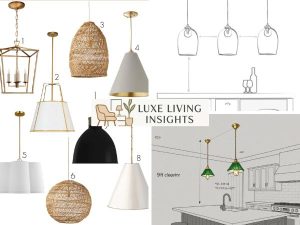
Note: Measure from the countertop, not the sink bottom. The countertop is your consistent reference plane across kitchens.
Choose the right height in 60 seconds
Use this quick decision path to land on a height that fits your ceiling, pendant size, and (most importantly) window placement.
- Start at 34 inches above the countertop.
(This sits in the middle of the 30–36″ standard range and works as a strong baseline.) - Is your sink in front of a window?
Yes → raise toward 36–40″ to protect sightlines and reduce reflection/glare off glass.
No → keep 30–36″ unless other factors below apply. - Is your ceiling 9 ft or higher?
Yes → add ~2–4 inches (often landing around 36–40″) to keep proportions balanced. - Is the pendant “visually large” (wide shade / bulky profile)?
Yes → raise 2–3 inches to avoid a heavy look and improve visibility. - Are household members tall (about 6 ft+), or do you lean deeply into the sink?
Yes → aim toward the top end of the range (36–40″) for better head clearance. - Final check: stand at the sink, look forward, and simulate washing dishes for 10 seconds. If the pendant feels “in your face,” raise it.
Ceiling-height table – recommended pendant drop
The 30-36″ guideline assumes an average 8–9 ft ceiling. Use this table as a quick adjustment reference. (Measurements are from countertop to the bottom of the pendant.)
| Ceiling height | Recommended pendant bottom height above countertop | Why this range works |
|---|---|---|
| 8 ft | 30–34″ | Prevents the pendant from feeling too high while still avoiding head bumps. |
| 9 ft | 34–38″ | Maintains good proportions as ceiling volume increases. |
| 10 ft | 36–40″ | Helps the fixture feel balanced and keeps sightlines open near windows. |
| 11–12 ft | 38–42″ (or use an extended rod) | Often requires longer downrods to avoid an “underscaled” look. |
If you’re unsure, choose the lower end for focused task lighting, and the higher end when you need clearer views (especially with a window).
Choosing pendant diameter for your sink
Height is only half the equation. A pendant that’s too wide over a narrow sink can look crowded and block your view; too small and it feels accidental. A practical sizing rule is to aim for a pendant diameter around one-third to one-half the sink width (or the cabinet width if that’s your cleaner reference).
| Typical sink/cabinet width | Recommended pendant diameter | Notes |
|---|---|---|
| 24″ | 8–12″ | Best for compact sinks; keeps the fixture from dominating the view. |
| 30″ | 10–14″ | A common sweet spot for many single-bowl sinks. |
| 33″ | 12–16″ | Works well if you want a stronger visual statement. |
| 36″ | 14–18″ | Consider raising height slightly if the shade is wide or opaque. |

Single pendant vs. two minis: Over most sinks, one pendant is the cleanest solution. Two mini pendants can work only if your sink zone is wide and you’re matching a multi-pendant rhythm elsewhere (like an island). Otherwise, it often looks busy.
Placement tips: window sightlines, head clearance, and glare
1) If the sink is in front of a window, prioritize sightlines
A sink-under-window layout is common—and it’s the #1 reason the “perfect” pendant height ends up higher than expected. If the pendant interrupts the middle of your window view, raise it toward 36–40 inches above the countertop or choose a more open-frame pendant that visually disappears.

2) Keep the pendant centered over the sink (not the faucet)
Faucets aren’t always centered to the basin. Center your pendant over the primary work area (usually the basin centerline) so the light falls where your hands are. If you have a double-bowl sink, center over the bowl you use most.
3) Avoid head-bump territory
If anyone in the household is tall or you lean far into the sink, test by “acting it out.” When you bend slightly forward, the bottom of the pendant should feel above eye level and never in your personal space. If it feels close, raise it a couple inches.
4) Don’t forget the backsplash reflection factor
Glossy tile, quartz, stainless steel, and glass can throw light back at you. If you notice glare, raise the pendant a touch, switch to a softer bulb, or use a dimmer.
If you’re planning a broader lighting refresh, this guide helps you layer lighting intentionally (instead of just adding fixtures): How to Decorate Your Room With Lights.
Bulbs & brightness with task lighting without harsh glare
Over a sink, you want light that’s clear and functional—but not clinical. The pendant’s shade and bulb choice affect both glare and accuracy. If you prep food at the sink or check stains on dishes, consider light that renders color well.
- Choose the right bulb type: LED is typical today, but base types and bulb formats still vary by fixture. If you’re unsure, read: 3 Types of Light Bulbs.
- Prioritize true color: Better color rendering helps countertops, food, and finishes look “right,” especially at night. See Lighting Is Most Accurate for True Color?.
- Use a dimmer when possible: Bright for cleanup, softer for evenings—especially useful if the sink pendant is visible from living spaces.
If your goal is more ambiance than task lighting (for example, you entertain in an open kitchen), you can still keep the sink pendant functional while building mood around the room using layers and warmer settings: How to Create Sexy Mood Lighting at Home.
Simple measuring steps (before you drill)
Use this quick process to lock in the right height before installing. It prevents the most common mistake: hanging the pendant at “standard island height” and then realizing it blocks the window or feels too low when you use the sink.
- Measure from the countertop up and mark your target height (start at 34″).
- Adjust using the decision tree: raise for windows, high ceilings, large shades, or tall users.
- Mock it up: hold a cardboard circle the size of the pendant diameter at the planned height to test sightlines.
- Stand at the sink and simulate dishwashing-check for glare and “in-your-face” feeling.
- Confirm centerline over the basin (not necessarily the faucet), then finalize the electrical box placement.
If you’re working around an existing ceiling point and don’t want to run new wires, you may prefer lighting options that don’t require rewiring: how to add lighting to a room without wiring.
FAQs
Is 30 inches or 36 inches better over a kitchen sink?
Both can be correct. Start in the middle (around 34″). Go closer to 30–32″ for an 8-ft ceiling and tighter task lighting. Go closer to 36–40″ if you have a 9+ ft ceiling, a large pendant, tall users, or a sink in front of a window.
Do you measure pendant height from the countertop or the sink?
Measure from the countertop to the bottom of the pendant. Countertops are consistent; sink depths vary widely.
What if my sink is directly in front of a window?
Prioritize the view. Raise the pendant toward 36–40″, choose a more open-frame design, or use a smaller diameter so you don’t block the center of the window.
How big should the pendant be over a kitchen sink?
A practical target is roughly 1/3 to 1/2 of the sink (or cabinet) width. Use the size table above as a quick guide, then adjust smaller if the pendant sits in front of a window.
Should I use one pendant or two mini pendants over the sink?
Most sinks look best with one pendant centered over the basin. Two minis can work only when the sink zone is wide and you’re intentionally echoing a multi-pendant layout elsewhere.
What bulb is best for a sink pendant?
Choose a bulb that supports clear task lighting and good color appearance. If you want finishes and food to look natural. If you’re unsure about bulb categories, start here: What Are the 3 Types of Light Bulbs.
How do I prevent glare over the sink?
Raise the pendant slightly, use a dimmer, and consider a shade that diffuses light (instead of a clear glass that exposes a bright bulb). Also check reflections from glossy backsplash tile, quartz, and stainless steel.
What’s the biggest mistake people make with sink pendants?
Hanging the pendant at a “standard” height without testing real use then realizing it blocks a window view or feels too low when leaning into the sink. Always do a quick mock-up and sightline test before final installation.
Articles on the same topic:
-

How to Get Water Stains Out of Fabric Chairs: The Ultimate 2026 Restoration Guide
-

How Much Does It Cost to Install 4 Recessed Lights? (2026 Price Guide)
-

How Many Pendant Lights Over a 9-Foot Island? The Designer’s Sizing & Spacing Guide
-

Choose Rattan Wicker Outdoor Furniture That Lasts
-
15 Decorating Ideas for a Feng Shui Bathroom That Boost Chi
-

Compare Wicker vs Rattan vs Cane: What’s the Difference?