
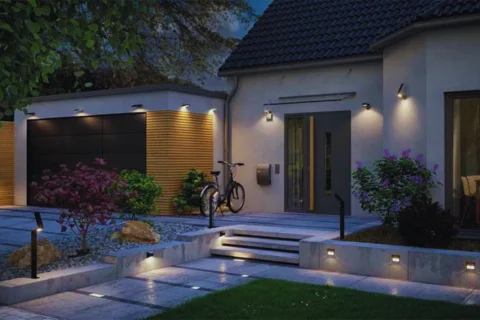
Yes modern front porch lighting can boost curb appeal fast because it instantly upgrades what people notice first: the entry “frame” around your door, the walkway approach, and the glow that makes your home feel intentional after dark. To start, you’ll get the quickest visual lift by choosing a clean-lined fixture style, matching finishes, and dialing in warm, flattering brightness.
Next, the best modern front porch lighting ideas aren’t just “pretty fixtures” they’re a layered system. When you combine wall sconces (vertical framing), a ceiling light or pendant (overhead glow), and subtle pathway/step lighting (ground-level guidance), the entrance looks polished and safer in one weekend.
In addition, placement and proportion are where “modern” either looks high-end or looks off. If your lights are too small for the door, hung at the wrong height, or too blue/bright, curb appeal drops even if the fixtures are expensive.
Finally, we’ll move from inspiration to execution: fixture types, exact placement, brightness and color temperature, sizing rules, finishes that last outdoors, and the fastest upgrades you can do without remodeling. Below is the step-by-step playbook.
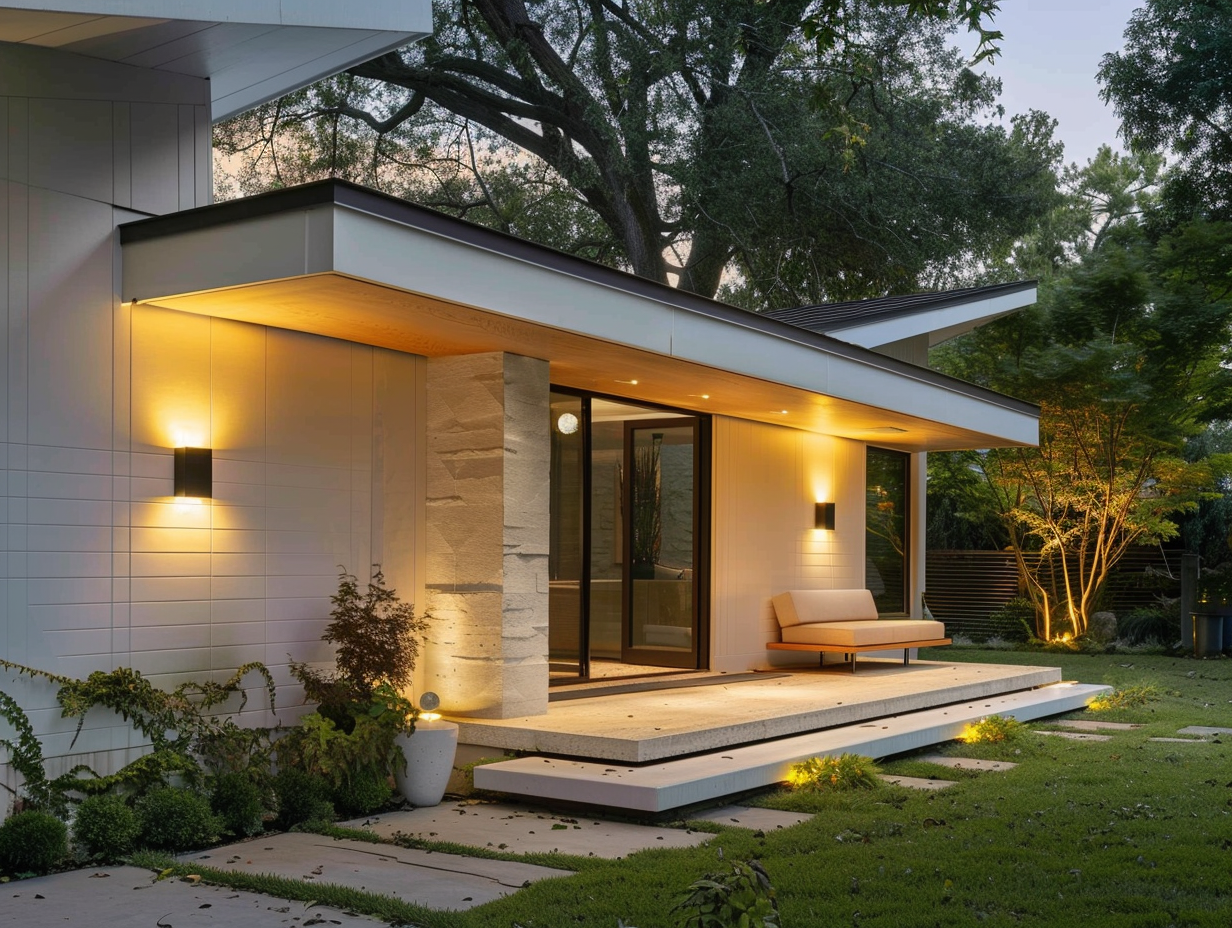
What makes front porch lighting “modern,” and how does it boost curb appeal fast?
Modern front porch lighting is a clean, simplified lighting approach minimal silhouettes, intentional light direction, and warm, controlled brightness that makes your entry look updated immediately because it improves symmetry, contrast, and night-time clarity.
To connect the dots, “modern” is less about one trendy shape and more about a consistent visual language: fewer decorative flourishes, better proportion, and light that’s aimed where people actually look and walk.
What is modern front porch lighting?
Modern front porch lighting is exterior entry lighting designed with clean lines, uncluttered forms, and purposeful light distribution (often downlight or diffused glow) so the door area looks crisp, balanced, and contemporary without visual noise.
Specifically, modern porch lighting typically leans on these micro-signals:
- Hyponym examples (types of modern fixtures): cylinder sconces, rectangular boxes, slim lanterns, up/down lights, globe sconces, minimal pendants.
- Meronym examples (parts that signal “modern”): matte finishes, opal/frosted glass, integrated LED modules, low-profile backplates, concealed hardware.
- Synonym cues (similar concepts): contemporary, minimalist, streamlined, clean-lined.
In practice, modern porch lighting focuses on shape + spacing + softness: shape that matches your architecture, spacing that frames your door, and softness that feels welcoming (not harsh).
Does modern lighting really improve curb appeal quickly?
Yes modern front porch lighting ideas can improve curb appeal quickly for at least three reasons: (1) they upgrade the entry focal point instantly, (2) they make the home look newer at night, and (3) they create symmetry and visual “order” even if the porch décor stays the same.
However, the “fast” effect depends on choosing the right levers:
- Leverage #1 (biggest impact): replace dated fixtures with modern silhouettes sized correctly for the door.
- Leverage #2: unify finishes (e.g., all matte black or all bronze) so the entry looks curated.
- Leverage #3: switch to warm, controlled brightness (often 2700K–3000K) to avoid the “blue glare” look.
Evidence line: According to DarkSky’s residential luminaire criteria (used for outdoor lighting approval), keeping output controlled and color temperature at or below 3000K supports responsible, comfortable outdoor lighting exactly the qualities that make an entry look refined instead of overlit.
Which modern front porch lighting ideas work best by fixture type?
There are six modern front porch lighting fixture “families” that work best depending on your porch layout: wall sconces, ceiling-mounted lights, hanging pendants, recessed/strip lighting, pathway/step lighting, and statement accents. The fastest curb appeal wins usually start with sconces.
Next, choose fixture types like building blocks: start with a “base layer” (overhead or sconces), then add a guiding layer (path/steps), and finish with a detail layer (accent or statement).
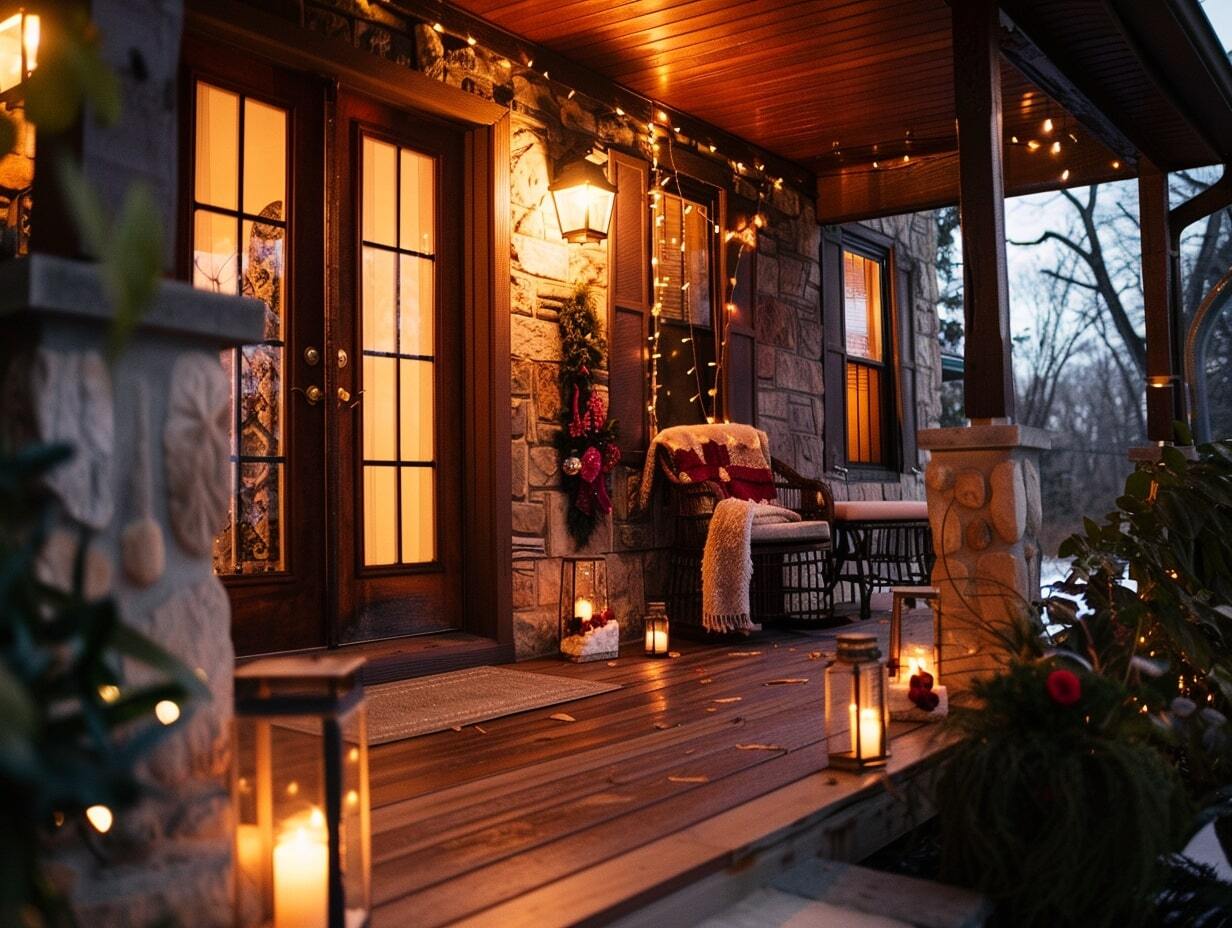
What modern wall sconce ideas look best on a front porch?
The best modern wall sconce ideas are slim lanterns, rectangular boxes, cylinders, and opal-globe sconces because they frame the door cleanly and provide flattering vertical light without clutter.
Specifically, choose a sconce style based on your façade:
- Flat, modern façade: rectangular box sconces, linear LED sconces, up/down lights.
- Transitional or modern farmhouse: simplified lanterns with clear or lightly seeded glass (minimal trim).
- Brick/stone texture: cylinder sconces or soft-glow opal diffusers to avoid harsh shadows.
To keep it modern, avoid overly ornate scrollwork and tiny fixtures that look “stuck on.”
Which ceiling-mounted porch lights feel modern, not builder-grade?
Modern ceiling-mounted porch lights are low-profile flush mounts, semi-flush drums, and clean geometric fixtures with diffused lenses that spread light evenly and don’t visually overwhelm a covered entry.
In addition, ceiling mounts are your “quiet hero” for fast curb appeal because they reduce dark patches under a porch roof. Look for:
- Simple shapes (drum, dome, cylinder)
- Diffuse lens or opal glass (so the bulb isn’t glaring)
- Damp-rated construction for covered porches
Are modern hanging pendants or lanterns worth it for a front porch?
Yes modern hanging pendants are worth it when your porch has enough ceiling height and depth, because a pendant creates a strong “entry moment” that reads upscale and intentional from the street.
However, pendants fail when they’re too low (people bump them) or too small (they look like a tiny afterthought). If your porch is shallow, a semi-flush is often the better modern choice.
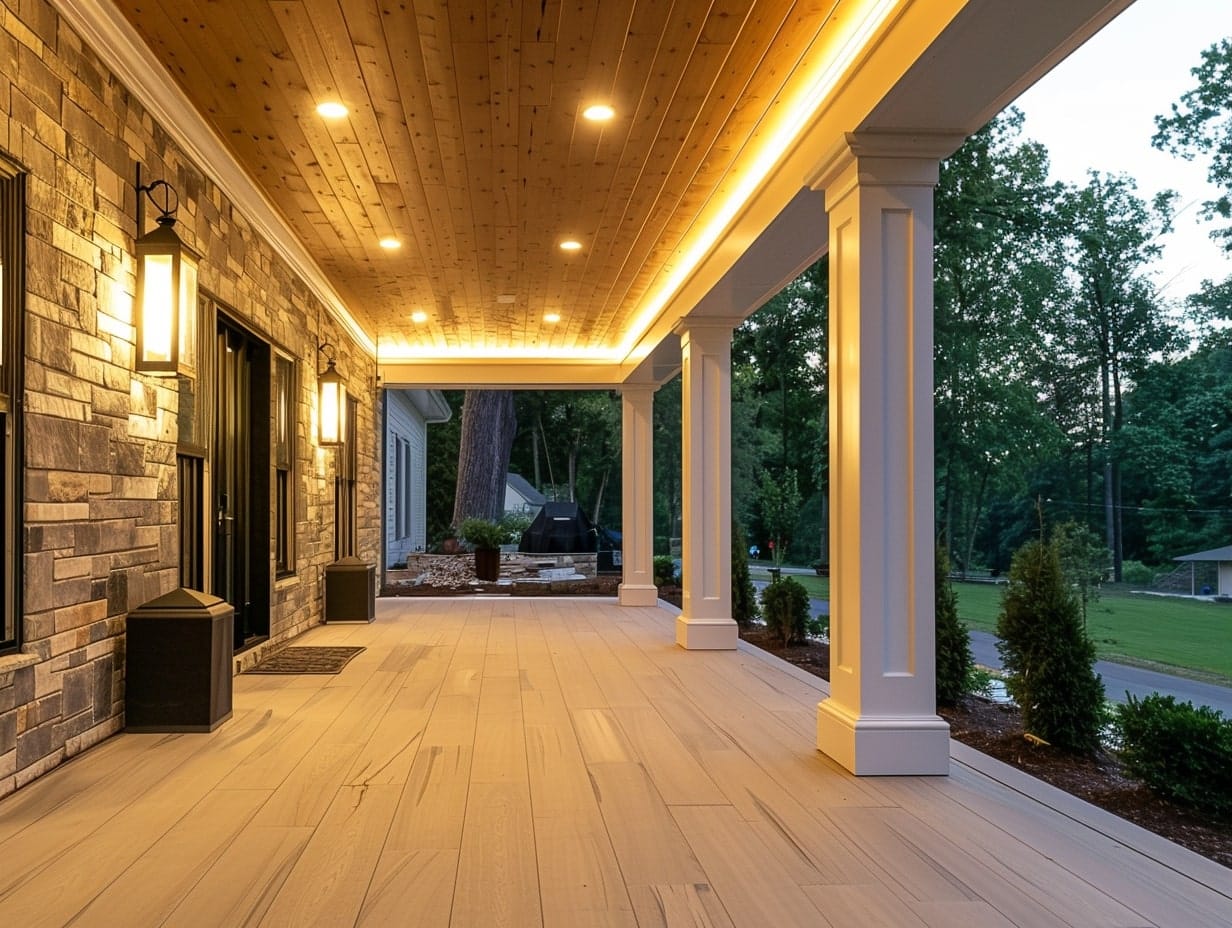
What recessed and LED strip lighting ideas look modern on a porch ceiling?
The most modern recessed and LED strip ideas use discreet points of light (recessed cans) or hidden glow (strip lighting) to create a clean ceiling plane and an architectural halo without showing bulky fixtures.
To illustrate, two high-impact options:
- Recessed downlights: evenly spaced for a calm, hotel-like ceiling.
- Cove-style LED strips: tucked into trim or a perimeter channel for soft indirect light.
Which pathway and step lighting ideas boost curb appeal the fastest?
The fastest pathway and step lighting upgrades are low-glare path lights, step lights, and subtle in-ground markers because they make the approach look premium and improve safety without changing the façade.
Specifically, prioritize the “approach line” people walk:
- Path lights along the main walkway (consistent spacing)
- Step lights on risers or side walls for stairs
- Low-level landscape wash to guide without spotlighting
What statement-piece lighting still counts as “modern” (not trendy)?
A modern statement piece is a single bold fixture (oversized pendant, sculptural lantern, or minimalist chandelier) that emphasizes proportion and negative space so it feels architectural, not fussy.
For a “fast” curb appeal upgrade, make the statement piece the only star, and keep supporting fixtures simple and matching in finish.
How should you place porch lights for maximum curb appeal and safety?
Place porch lights to create symmetry, eliminate shadows, and guide movement: frame the door with sconces, add an overhead layer for the covered area, and use low-level lighting to define the walkway and steps without aiming glare at faces.
To start, think like a photographer: you’re lighting the door as the subject, the porch as the stage, and the path as the lead-in line.

Where should porch sconces go in relation to the front door?
Porch sconces should flank the front door when possible because symmetrical framing reads “designed,” improves facial visibility at the lock, and prevents the door from looking like a dark hole at night.
Specifically:
- Single door: ideally two sconces, one on each side (space permitting).
- Door with sidelights: sconces go outside the sidelights, not squeezed between panes and trim.
- Double door: either two large sconces flanking the pair, or four smaller sconces if the façade supports it.
If you only have room for one sconce, place it on the latch side (where you stand to unlock), then add an overhead light to balance it visually.
What is the best mounting height for modern front porch lighting?
The best mounting height for modern porch sconces is typically 60–72 inches from the ground (to the fixture) so the light lands around face level without glaring upward, while pendants/ceiling lights should clear walking height comfortably.
In addition, keep these fast rules in mind:
- Sconces: aim for the center of the light source around ~66 inches for most entries; adjust for very tall doors.
- Pendants: keep the bottom of the fixture at least ~7 feet above the porch floor.
- Ceiling lights: maintain a similar clearance so the space feels open, not crowded.
Evidence line: According to a lighting placement guide published by Urban Ambiance, outdoor wall sconces are commonly hung 60–72 inches off the ground, and outdoor pendants should maintain a minimum of 84 inches (7 feet) from the base of the fixture to the floor.
Should you use one light or two lights on a front porch?
Yes two lights are usually better than one because (1) they create symmetry, (2) they reduce harsh shadows at the door, and (3) they let you use lower brightness per fixture for a softer, more modern look.
However, one light can still look great when architecture limits you. In that case, balance it with a ceiling fixture or pathway lights so the composition doesn’t feel lopsided.
How do you layer porch lighting without overdoing it?
Layer porch lighting with three roles ambient, task, and guidance so each light has a job and no single fixture needs to be “blinding” to cover everything.
Specifically:
- Ambient (overall): ceiling light, pendant, or recessed lights under the porch roof.
- Task (door/lock): sconces near the entry, aimed to illuminate hands and faces.
- Guidance (path/steps): low-level lights that show edges and elevation changes.
As a modern rule, if you notice the brightness more than the design, you’re probably overlighting.
What brightness and color temperature look best for modern curb appeal?
Modern curb appeal looks best with warm, controlled brightness: enough lumens to see faces and steps clearly, paired with a warm-white color temperature (often 2700K–3000K) that flatters materials and avoids the harsh “blue security light” look.
Next, treat brightness and color like makeup lighting: you want flattering, even illumination, not spotlight glare.
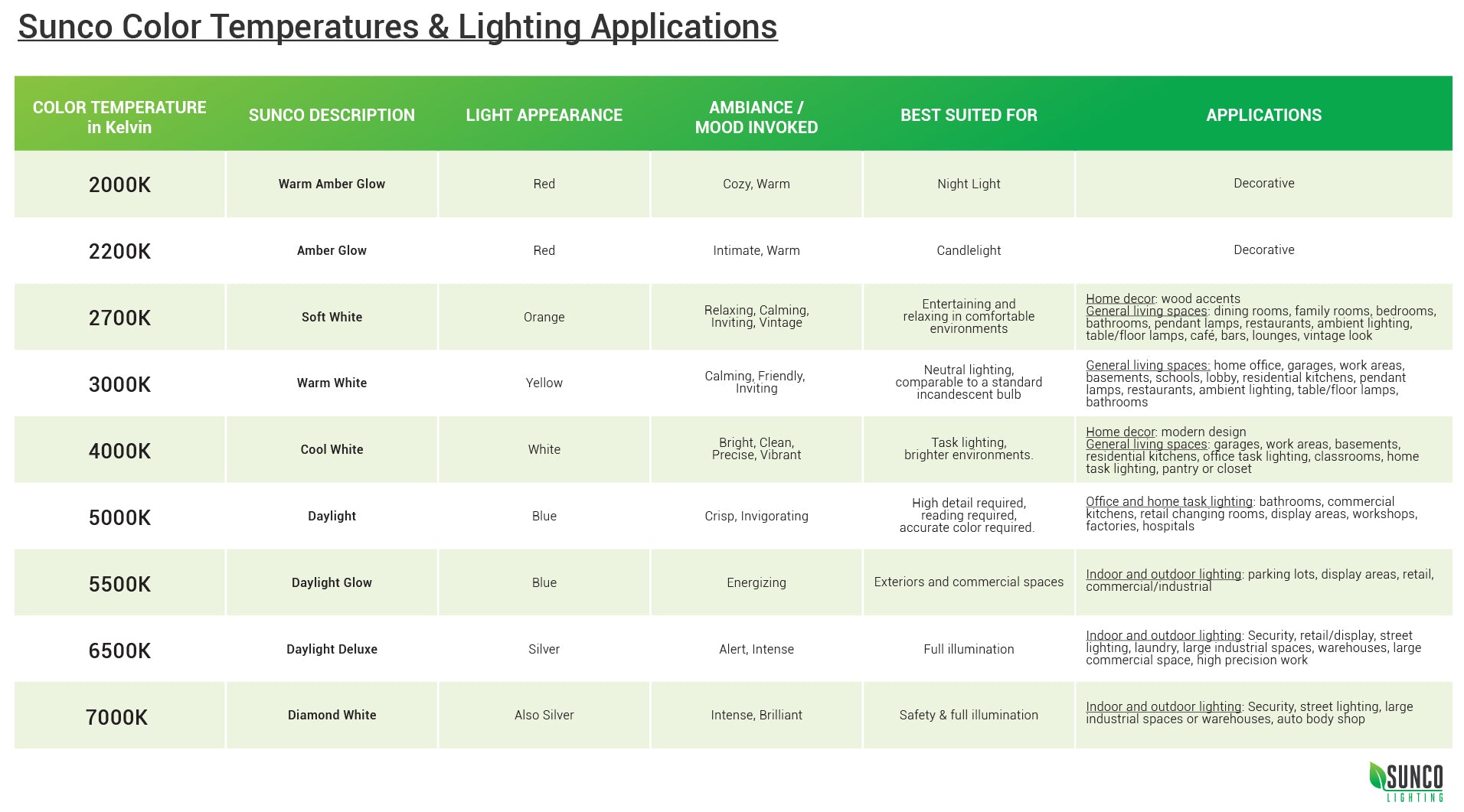
How many lumens do you need for a modern front porch?
You typically need “moderate” lumens at the entry enough for safe walking and clear facial recognition because modern lighting looks best when it’s controlled and layered rather than extremely bright from one fixture.
Specifically, aim for these practical targets (then adjust based on layering):
- Wall sconces: moderate output each (two fixtures usually beat one high-output fixture).
- Ceiling/pendant: soft ambient fill under the porch roof.
- Path/steps: low-level guidance lighting (glare-free).
Evidence line: According to DarkSky’s residential luminaire guidelines, residential outdoor fixtures intended to reduce glare and skyglow are often capped at 1,000 lumens total output, reinforcing the “controlled brightness” approach that also looks more modern.
Is 2700K or 3000K better for modern porch lighting?
2700K wins for warmth and coziness, while 3000K looks slightly crisper and more contemporary so 2700K is best for traditional/transitional homes, and 3000K is often ideal for modern façades with stone, concrete, or black trim.
However, avoid cooler temperatures (like 4000K+) for the porch if your goal is curb appeal. Cool light can make skin tones look flat and can turn warm materials (wood, brick) visually gray.
Evidence line: DarkSky’s outdoor lighting programs and materials commonly reference 3000K (or lower) as a key threshold to limit blue light and improve visual comfort an alignment with what homeowners perceive as “welcoming” light.
How do you reduce glare and “cheap-looking” harsh light?
Reduce glare by using diffusers, shielding, and lower brightness per fixture so the light source isn’t directly visible and the porch looks softly illuminated rather than spotlighted.
Specifically, use these modern anti-glare moves:
- Opal/frosted glass instead of clear glass with an exposed bulb.
- Downward-directed light (shielded fixtures) to prevent light at eye level.
- Dimmer compatibility so you can tune the “glow” instead of guessing.
Should you use dimmers, smart bulbs, or photocells for curb appeal?
Yes smart control is one of the fastest curb appeal upgrades because it lets you keep a consistent warm glow at night, then brighten only when needed.
In practice:
- Dimmers: best for covered porches where you want a steady, adjustable ambiance.
- Smart bulbs/switches: great for schedules (“on at sunset, dim at 11pm”).
- Photocells: convenient, but choose warm CCT and avoid over-bright fixtures that stay blazing all night.
How do you choose the right fixture size and proportion for the front door?
Choose fixture size by proportion, not guesswork: modern porch lighting looks best when sconces visually “match” the door height and width, pendants clear the walking zone, and everything feels scaled to the architecture neither tiny nor oversized.
Next, use simple sizing formulas so your modern upgrade reads intentional from the street.

What is the best size rule for porch sconces next to a door?
A reliable size rule is: sconce height ≈ 20%–25% of the door height so the fixture looks balanced and visible, not undersized or cartoonishly large.
To apply it quickly:
- 80-inch door: sconce height often looks right around 16–20 inches.
- 96-inch (8-foot) door: sconce height often looks right around 19–24 inches.
Evidence line: A published sizing guideline from Urban Ambiance notes that outdoor wall fixtures are commonly sized so fixture height is about 20%–25% of door height an easy proportional anchor that prevents “too small” curb appeal mistakes.
How wide should porch sconces be, and how much space do you need?
Sconce width should fit the wall “breathing room” around your trim so the fixture doesn’t crowd the door casing or look lost on a wide façade.
Specifically, check these constraints:
- Trim clearance: leave a comfortable gap between the fixture and door trim so it doesn’t feel jammed.
- Door hardware zone: avoid mounting where the light blocks the handle/lock sightline.
- Visual weight: on wide façades, slightly wider/longer sconces often look more modern than tiny lanterns.
How do you size a ceiling light or pendant for a covered porch?
Size ceiling fixtures to the porch footprint and ceiling height so the light looks centered and proportional, and keep the fixture bottom high enough for comfortable clearance.
In addition:
- Shallow porch: use flush or semi-flush to avoid visual clutter.
- Deeper porch: pendants can work if the ceiling height supports the drop.
- Very tall ceiling: a larger fixture prevents the “tiny dot in space” look.
Which finishes and materials look most modern outdoors and last?
The most modern, durable outdoor looks combine matte finishes with weather-smart materials: matte black, bronze, or dark graphite with aluminum/stainless frames, quality powder coating, and sealed glass so the fixtures keep their curb appeal through sun, rain, and temperature swings.
Next, modern is as much about “staying clean-looking over time” as it is about today’s trend.

Is matte black the most modern finish for a front porch?
Yes matte black is one of the most consistently modern porch finishes because it (1) creates crisp contrast on light exteriors, (2) hides minor wear better than glossy finishes, and (3) pairs cleanly with modern hardware, house numbers, and door pulls.
However, the best finish is the one that matches your home’s “metal story.” If your door hardware is satin nickel, a soft black or dark graphite still works, but try to avoid mixing three or more different metal tones at the entry.
Which glass and diffuser materials look modern (and reduce glare)?
Opal and frosted glass look most modern for curb appeal because they diffuse light evenly, reduce visible bulb glare, and create a smooth “glow block” effect that reads higher-end than clear glass with a harsh filament.
To illustrate:
- Opal globe: soft, sculptural, minimal great for true modern homes.
- Frosted panels: modern lantern look without exposing the bulb.
- Clear glass: can look modern only if the bulb is warm and the fixture is well-shielded (otherwise it looks glaring).
What materials hold up best in coastal or harsh-weather climates?
In coastal or harsh climates, prioritize corrosion-resistant builds such as marine-grade finishes, stainless steel components, sealed gaskets, and fixtures rated for the exposure level (covered vs fully exposed).
Specifically:
- Coastal/salty air: look for marine-grade or coastal-rated finishes and avoid cheap painted steel.
- Hot sun: UV-stable powder coat and quality plastics (if used) prevent yellowing.
- Freeze/thaw: sealed glass and tight gaskets help prevent moisture intrusion.
Should you use natural materials (like rattan) on a front porch?
Yes natural materials can still look modern when used as a controlled accent (one statement piece) and when they’re appropriately rated and protected (covered porch, damp-rated locations).
However, natural fibers outdoors are more maintenance-heavy. If you want the vibe with less worry, look for weather-rated composites or “rattan-look” materials designed for exterior use.
What are the highest-impact “fast” upgrades vs bigger remodel upgrades?
The fastest modern porch lighting upgrades are swaps and controls: new fixtures, warmer bulbs, dimmers/smart schedules, and pathway lights. Bigger upgrades like adding new junction boxes, recessed lighting, or reworking the porch ceiling deliver more transformation but take more time and budget.
Next, choose your upgrade path based on your timeline: “this weekend” vs “this season.”
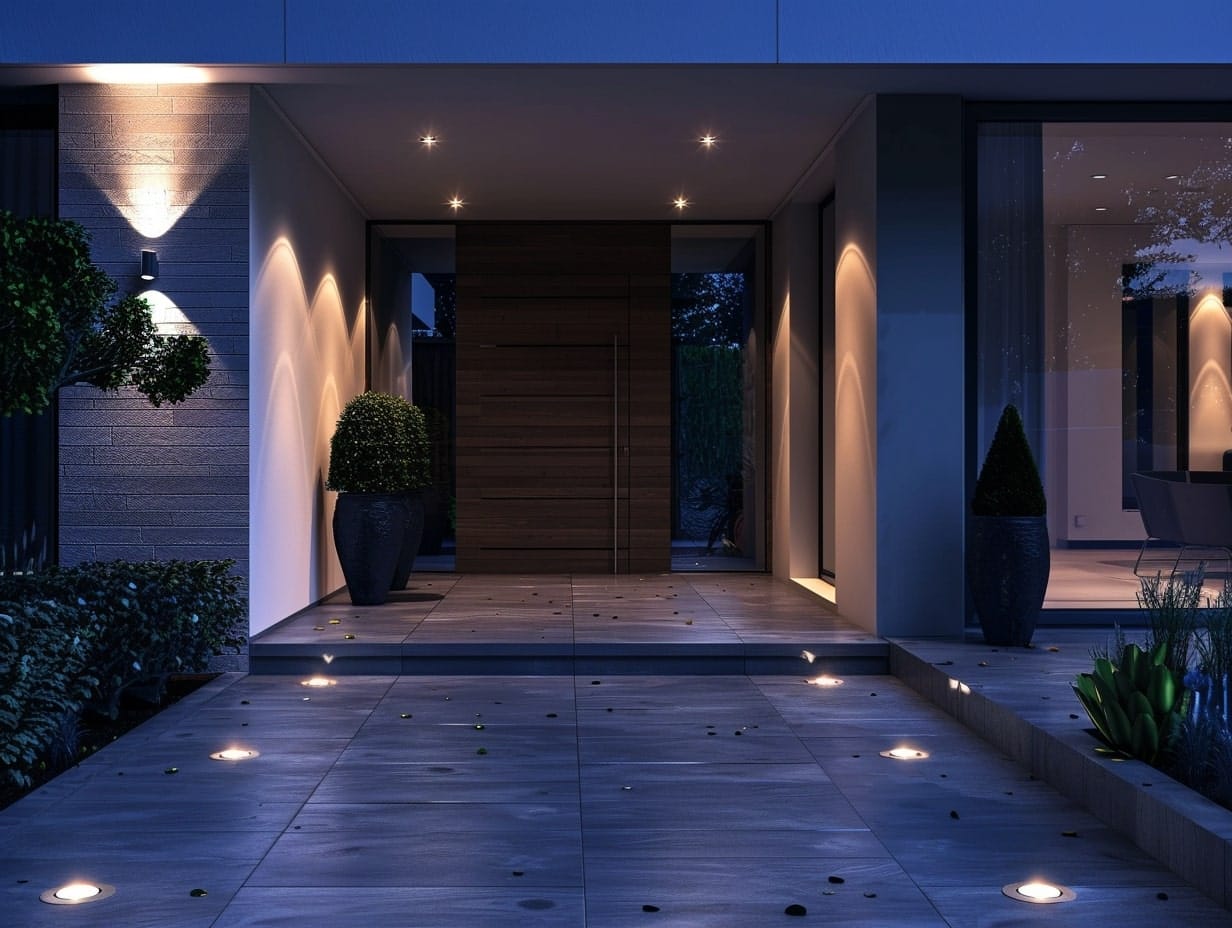
What are the fastest modern porch lighting upgrades you can do in a weekend?
You can do four fast upgrades in a weekend: swap dated fixtures, switch to warm bulbs, add dimming/smart control, and add low-glare path or step lights each one improves the “night photo” of your home immediately.
Specifically, a high-impact weekend checklist:
- Replace fixtures: choose a modern silhouette and correct size.
- Unify finishes: match the two sconces + overhead (and ideally door hardware).
- Warm the light: set bulbs to 2700K–3000K and reduce glare with diffusers.
- Add a schedule: sunset-on + late-night dim to keep the entry consistently inviting.
Which upgrades feel “fast” but look expensive?
The “looks expensive” fast upgrades are oversized sconces, coordinated metal finishes, and layered lighting that includes subtle pathway/step illumination because they change proportion and composition, not just brightness.
To illustrate, even one of these can lift the whole entry:
- Oversize sconces (scaled to door height)
- Modern house numbers + matching sconce finish
- Shielded downlight sconces (no exposed bulb glare)
What bigger upgrades create the most dramatic modern transformation?
The most dramatic upgrades add new light layers: recessed ceiling lights, integrated LED strip coves, new wiring for balanced sconces, or a statement pendant sized to the porch volume.
In addition, bigger upgrades are worth it if your porch currently has only one harsh light source or deep shadows under a roofline.
What common mistakes make modern porch lighting look cheap or dated?
Modern porch lighting looks cheap or dated when scale, color, and control are wrong: tiny fixtures on big doors, cool/blue bulbs, exposed glaring light sources, mismatched finishes, and incorrect exposure ratings that lead to rust and cloudy glass.
However, these mistakes are easy to fix once you know what to check.

Are your porch lights too small for the front door?
Yes if your sconces look tiny compared to the door, they’ll read dated because (1) they break proportion, (2) they don’t frame the entry, and (3) they often force you to use harsher brightness to compensate.
To fix it fast, use the door-height proportion rule and size up one category. Modern design usually looks better slightly larger than slightly smaller.
Is cool white light (4000K+) making your entry look harsh?
Yes cool white light often makes a porch look harsh and “security-light” dated because (1) it increases perceived glare, (2) it flattens warm materials like wood and brick, and (3) it can make the entry feel less welcoming.
Instead, switch to a warm range (often 2700K–3000K) and add dimming so the same fixture can feel inviting at night and still be bright enough when needed.
Are you mixing too many finishes at the entry?
Yes too many finishes can make a modern entry look busy because modern style relies on cohesion. If you mix black sconces, brass numbers, chrome hardware, and copper accessories, nothing feels intentional.
As a quick rule: pick one dominant metal finish, one supporting finish, and keep everything else neutral.
Did you choose the wrong rating (damp vs wet) for your porch location?
Yes using the wrong rating can ruin curb appeal fast because moisture intrusion leads to rust, peeling finish, and cloudy glass. Damp-rated fixtures are for protected covered porches, while wet-rated fixtures are for direct rain/snow exposure.
Evidence line: According to Schoolhouse’s wet-rated vs damp-rated lighting explainer, damp-rated fixtures are suitable for covered outdoor use, while wet-rated fixtures are intended for direct exposure to rain and snow.
Are you overlighting the porch instead of layering it?
Yes overlighting is a common “cheap-looking” mistake because it creates glare and hard shadows. Layering lets you use lower output per fixture, which reads softer and more modern.
To fix it: reduce bulb output, add a dimmer, and include low-level guidance lights instead of turning one fixture into a spotlight.
Source:
- https://garden.lighting/content/images/size/w2000/2024/03/front-porch-lighting-ideas.png
- https://garden.lighting/content/images/2024/03/layered-light-on-a-front-porch.jpg
- https://garden.lighting/content/images/2024/03/recessed-lights-into-the-porch-ceiling.jpg
- https://ucarecdn.com/053c0e97-cf3b-4bab-b881-69e1b3f2cb39/-/format/auto/-/preview/1024×1024/-/quality/lighter/Outdoor-Wall-Sconce—Porch.jpg
- https://www.alconlighting.com/wp-content/uploads/2019/11/Color_temperature_guide.jpeg
- https://ucarecdn.com/a679826e-7577-4691-abd3-a3cd2e48730f/-/format/auto/-/preview/1024×1024/-/quality/lighter/Outdoor-Pendant—Porch.jpg
- https://cdn.shopify.com/s/files/1/0011/5517/0351/files/Sunco_Blog_20191203_CCTCHART_7c49b8f8-e151-45ea-91b9-eaf57fe8672f_2048x2048.jpg?v=1666742013
Articles on the same topic:
-
How to Remove a Fluorescent Light Cover (Lens) Safely: Tabs, Clips, and Sliding Diffusers
-

How Many Pendant Lights Over a 5 Foot Island? The Definitive Spacing & Sizing Guide
-

Set the Perfect Chandelier Height Above Dining Table: Inches, Ceiling Rules & Sightlines
-
How to Add Lighting to a Room Without Wiring With 10 Smart Solutions
-
What Is Scandinavian Design and What Makes This Style So Distinctive
-
Feng Shui Bedroom Decor Ideas for Better Sleep