Designing a kitchen island layout is often a game of inches. When you are working with a standard 5-foot (60-inch) kitchen island, the margin for error is slim. Choose lights that are too big, and your kitchen feels cluttered; choose lights that are too small, and the design looks unfinished.
In this guide of luxelivinginsights.com , we dive deep into the specific mathematics and aesthetic rules for 2026 to help you achieve that high-end, custom look.

Quick Summary
For a standard 5-foot (60-inch) kitchen island, the professional recommendation is two pendant lights. This configuration provides optimal task lighting and visual symmetry without overcrowding the limited surface area.
-
- Primary Factor: Island length (60″) vs. Pendant Diameter (10-14″).
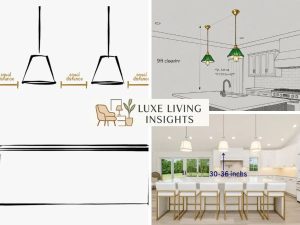
- Key Measurement: Place them 30 inches apart (center-to-center).
- Expert Recommendation: “Always prioritize the ‘Rule of Three’ for larger islands, but for 5 feet, ‘Less is More.’ Two medium-sized fixtures create a cleaner, more upscale aesthetic.” – Interior Design Collective 2026.
- Lighting Output Target: 600-900 lumens per pendant for food prep zones.
Table of Contents
Core Metrics for a 5-Foot Island – The 2026 Standard
When dealing with a 60-inch surface, every inch of “visual real estate” matters. According to the National Kitchen & Bath Association (NKBA), lighting should never overwhelm the workspace. While you might be tempted to follow general rules, specifics matter. If you are new to lighting design, you might want to read our broader guide on how to decorate your room with lights to understand the basics of layering.
This is why professional kitchen planners rarely “scale down” lighting rules from large islands instead, they apply micro-spacing logic tailored specifically to compact island footprints.
Comparison Table: 2 Pendants vs. 1 Statement Piece
| Feature | Dual Pendants (Recommended) | Single Large Statement |
|---|---|---|
| Visual Balance | Symmetrical & Traditional | Bold & Modern |
| Light Distribution | Even across the 60″ surface | Concentrated in the center |
| Ideal Diameter | 10″ – 14″ per fixture | 24″ – 30″ (Single) |
| Installation Cost | Higher (Requires 2 junction boxes) | Lower (1 junction box) |
The Math of Perfect Placement
To ensure your kitchen doesn’t feel lopsided, we use the Boundary-to-Center formula. For a 5-foot island ($L = 60 \text{ inches}$), we must account for the “buffer zone” at each end (usually 6 inches) to prevent the lights from hanging over the edge.
To calculate the ideal spacing between two pendants ($S$), we use:
If we use a standard 6-inch buffer from each end:
Note: The result of 24 inches represents the distance from the center of the island to the center of each light. However, usually, contractors measure center-to-center between the two lights. In this case, your two lights will be approximately 30 inches apart. This provides the most ergonomic Lumens distribution for food prep.
From a human-centric lighting perspective, a 30-inch center-to-center spacing also aligns with the average shoulder width and prep stance of a standing adult. This minimizes shadows caused by head and shoulder movement during chopping, mixing, and plating.
In other words, this spacing isn’t arbitrary, it’s optimized for real-world kitchen behavior, not just visual symmetry.
Choosing the Right Pendant Size (Scale & Proportion)
When shopping for pendants, also pay attention to fixture depth and visual mass, not just diameter. Two pendants with the same width can feel dramatically different depending on whether they use clear glass, opal diffusers, or solid metal shades.
For resale-friendly kitchens in 2026, designers increasingly favor medium-scale pendants with soft diffusion, as they photograph better and appeal to a wider buyer demographic.
A common error is choosing pendants that are too small, making them look like “floating golf balls.” For a 5ft island:
- Small Pendants (8-9″): Too diminutive; may require 3 lights (but will look cluttered).
- Medium Pendants (10-14″): The “Sweet Spot” for a pair.
- Large Pendants (16″+): Risk encroaching on the “head space” of people sitting at the island.

Installation Secrets: Height and Electrical Specs
When your licensed contractor arrives, don’t just wing the height. The technical specifications of your bulb matter immensely. You need to understand what are the 3 types of light bulbs commonly used in kitchens to ensure you aren’t mixing warm and cool temperatures.
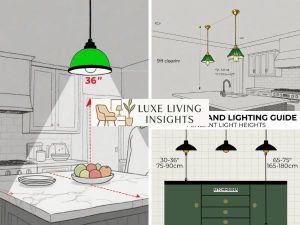
- Countertop-to-Bottom Distance: 30 to 36 inches.
- The 2026 “Eye-Level” Rule: If you are taller than 6 feet, aim for the higher end (36″) to ensure the fixture doesn’t obstruct your line of sight.
- Dimmers are Non-Negotiable: In 2026, smart-home integration is standard. This is key to creating the right atmosphere. For more inspiration on how lighting controls change a room’s feel, check out our guide on indoor mood lighting ideas that transform your home.
- Recommended Color Temperature: 2700K-3000K for residential kitchens.
- CRI Rating: 90+ to ensure accurate food color rendering.
- Beam Spread: Wide (100–120°) to avoid spotlighting.
Expert Note: “Always check the ‘Canopy’ size before cutting into your drywall. Some modern minimalist pendants have tiny canopies that won’t cover a standard 4-inch junction box. Similar to the precision required in how to install a picture light, getting the wiring height and angle correct before closing the wall is critical.”
Common Mistakes & Real-World Lighting Problems in 5-Foot Islands
Most kitchen lighting guides focus on ideal scenarios. In reality, 5-foot islands expose flaws faster than any other configuration from poor electrical planning to uneven illumination patterns that only become obvious after move-in.
- The Shadow Gap: If you place two pendants too far apart, you create a “dark zone” in the exact center of the island where you’ll likely be chopping vegetables.
- Maintenance: Open-shade pendants (where the bulb is visible) collect dust 30% faster than enclosed globes.
- Ambience: Kitchens are often multi-use spaces. Sometimes you want bright light for cooking, other times you want a softer vibe for wine with friends. Learning how to create sexy mood lighting at home can help you utilize your dimmer switches effectively for evening entertaining.
💡 Pro Tip: The “Rule of Thumbs” for Ceiling Height
“If your ceilings are higher than the standard 8 feet, add 3 inches of hanging height for every additional foot of ceiling. For a 10-foot ceiling, your pendants should sit about 36-39 inches above the counter. This maintains the ‘visual weight’ of the room without making the cords look like spindly spider webs.” — Lead Electrician, NYC Metro Lighting.
FAQs
Can I put 3 pendants over a 5 foot island?
- While technically possible, 3 pendants over a 60-inch island usually results in a “crowded” look. You would be forced to use very small (mini) pendants, which often lack the Lumens necessary for effective task lighting. Stick to 2 medium fixtures for a more professional finish.
What is the best diameter for lights over a 5ft island?
- The ideal diameter is 10 to 14 inches. This range provides enough presence to “anchor” the island without overwhelming the 60-inch length.
Should pendants be centered over the seating or the island?
- Pendants should always be centered over the total width and length of the island countertop, not just the seating area. This ensures the light pool covers the entire workspace.
Can I add recessed lighting along with pendant lights?
- Yes. Layering ambient lighting (such as recessed lights) with task lighting (pendants) is common in modern kitchens. Pendants should remain the primary focal task lights over the island.
Do pendant lights over a kitchen island help increase home resale value?
- Well-designed lighting can enhance perceived quality and aesthetics, making kitchens feel more custom and appealing to buyers, especially when lighting is both functional and visually cohesive.
Conclusion
Choosing the right lighting for a 5-foot island is a balance of mathematics and personal style. By sticking to two medium-sized pendants spaced roughly 30 inches apart, you ensure your kitchen remains both functional and high-end in its aesthetic. Remember to prioritize dimmable LED options and consult with a pro for the junction box placement.
What style are you leaning towards for your 2026 remodel? Drop a comment below if you’re torn between classic glass globes or the new matte black industrial look ! we’d love to help you decide!