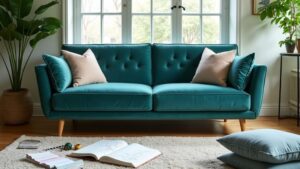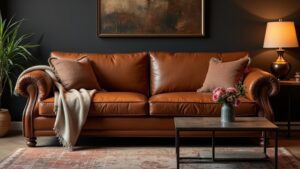
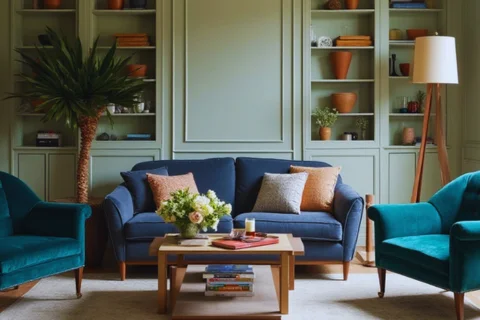
If you want the best accent chairs for a living room with a sofa, the goal is simple: choose chairs that balance your sofa in scale, comfort, and style without copying it. The right accent chair can make your seating area feel finished, inviting, and intentionally designed, even if your sofa is the biggest piece in the room.
Next, the smartest way to avoid an awkward “floating chair” look is to get the fit right first seat height, seat depth, chair width, and the walking space around each piece. When the proportions work, almost any style combination can look high-end.
Besides fit, the difference between “pretty in photos” and “great in real life” often comes down to color, pattern, and material choices. A chair that complements your sofa should either echo a shared tone (synonym) or provide a deliberate contrast (antonym) that still feels cohesive.
To begin, we’ll walk through a clear, step-by-step method from defining “complement,” to choosing types, colors, and fabrics then we’ll cross a contextual border into advanced, real-home factors like swivel clearance, pet-proof fabrics, and how lighting changes color.
What does it mean to “complement” (not match) your sofa when choosing accent chairs?
Complementing your sofa means choosing accent chairs that create a balanced look through proportion, color harmony, texture, or style contrast so the seating area feels cohesive without looking like a matching set .
In other words, “complement” is about relationship, not duplication. And that relationship can be built in more than one way:
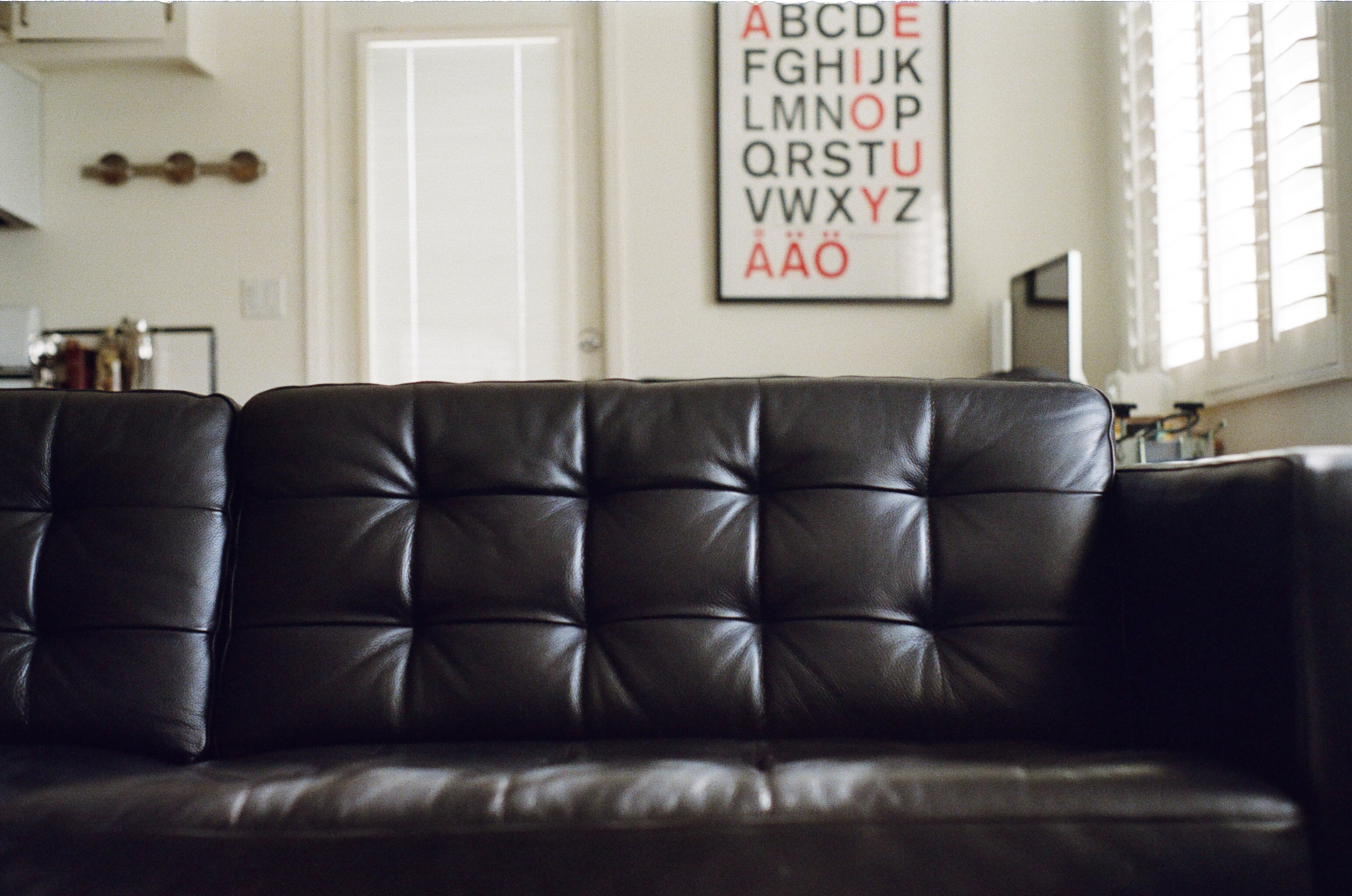
- Synonym approach (soft harmony): Your chairs share a similar “mood” with the sofa like warm neutrals with warm neutrals, or clean-lined modern with clean-lined modern.
- Antonym approach (intentional contrast): Your chairs create a controlled contrast like a curved barrel chair against a boxy sectional, or a woven rattan chair next to a sleek leather sofa.
- Meronymy approach (part-to-whole): You repeat one “part” of the sofa’s look such as leg finish, metal tone, or pillow color without repeating the entire sofa fabric.
- Hyponym approach (category-based): You choose chairs within a broader style family (e.g., “modern”) but in a different sub-style (e.g., modern sofa + mid-century accent chair).
After you decide how you want the relationship to work, you can make the rest of the decisions faster because you’ll know whether you’re building harmony, contrast, or a mix of both.
Do your accent chairs need to match your sofa?
No your accent chairs do not need to match your sofa, because (1) matching can flatten the room, (2) contrast adds depth and personality, and (3) coordinated variety tends to look more custom than a showroom set .
That said, “not matching” doesn’t mean “random.” The best-looking rooms still have rules just quieter ones.

Here are three reliable ways to coordinate without matching:
- Repeat one element (meronymy): If your sofa has walnut legs, choose chairs with walnut arms, a walnut side table, or even a walnut-framed print nearby.
- Share an undertone (synonym): A greige sofa and a creamy boucle chair can “talk” to each other because both feel warm and soft, even if they’re different materials.
- Use contrast with boundaries (antonym): If you go bold like a patterned chair keep something else calm (solid sofa, quieter rug, or simple curtains) so the room doesn’t get visually loud.
Next, once you decide you’re not aiming for a matching set, the practical question becomes: how do you prevent mismatched chairs from looking like they were added later? The answer is measurements and spacing because fit creates instant visual credibility.
Evidence (optional): Many design guides recommend prioritizing chair-to-sofa “sit alignment” (seat height and depth comfort) to make mixed seating feel like a single conversation zone rather than separate furniture pieces.
What should you measure first to ensure the chair fits your sofa and the room?
The simplest method is to measure (1) seat height alignment, (2) seat depth and comfort, (3) chair width vs. available space, and (4) clearances for walking and tables in that order .
To make this easy, imagine you’re measuring for two things at the same time: comfort (how it feels to sit) and flow (how it feels to move around the room).

What seat height and seat depth should you target to “sit well” with your sofa?
Target a seat height that’s close to your sofa’s seat height (often within a few inches), and choose a seat depth that matches how you lounge shallower for upright chatting, deeper for curling up .
Specifically, seat height matters because it affects how people naturally transition between sofa and chair in a conversation area. If one seat is dramatically higher, it can feel like sitting at two different “levels,” which looks and feels off.
- Seat height: Measure from floor to the top of the sofa cushion (where you actually sit), then compare it to the chair’s seat height.
- Seat depth: If your sofa is deep and loungey, a very upright, shallow chair can feel like a different “activity.” That can be good if intentional but it should be planned.
- Back height + pitch: A chair with a very upright back can look more formal next to a slouchy sofa. Again: great if intentional, awkward if accidental.
Evidence (optional): Ergonomics resources frequently note that seat height, seat depth, and back support are core comfort dimensions; when these are mismatched, users report discomfort faster especially in longer sitting sessions.
How much clearance do you need around accent chairs for traffic flow?
Plan for clear walking lanes so people can pass without turning sideways, and keep enough space to pull the chair out slightly without hitting tables or walls .
Here’s a practical way to measure clearance without overthinking:
- Main pathways: Identify the “must-walk” routes (to the hallway, kitchen, or door) and keep them as open as possible.
- Chair pull-back zone: Give each chair a little breathing room behind or beside it so it doesn’t feel wedged in.
- Table reach: If the chair is meant for real daily use, make sure there’s a side table within a comfortable reach for a drink or remote.
What chair width works best next to different sofa sizes?
Choose chair width based on sofa scale: large sofas and sectionals can handle wider chairs, while small sofas look best with slimmer silhouettes that don’t overpower the seating area .
A helpful visual rule: if your sofa is visually “heavy” (deep seat, thick arms, big back cushions), your chair should either match that visual weight or deliberately contrast with a lighter, airier shape like an open-frame chair.
Next, once measurements and fit are handled, choosing chair style becomes much simpler because you’re selecting from what actually fits your room and your sofa’s scale.
Which accent chair types work best with different sofa styles?
There are six dependable accent chair types that pair well with most sofas club, barrel, wingback, slipper, swivel, and cantilever because each type solves a different comfort-and-scale problem in a living room .

What chair types pair best with modern, clean-lined sofas?
Modern sofas pair best with barrel chairs, slipper chairs, and sculptural lounge chairs because they echo clean geometry while adding softer curves or lighter visual weight .
- Barrel chair: Adds curves to balance a straight sofa (antonym: curve vs. line).
- Slipper chair: Low profile; great for small rooms with modern sofas.
- Sculptural lounge chair: Creates a designer focal point without needing bold color.
What chair types work with traditional sofas (rolled arms, tufting, classic shapes)?
Traditional sofas work beautifully with wingback chairs, classic club chairs, and skirted chairs because they share familiar proportions and detailing, even if fabrics differ .
- Wingback: Adds height and a “heritage” feel.
- Club chair: A timeless partner especially in leather or textured weave.
- Skirted chair: Softens a formal sofa and hides legs in family spaces.
What chair types are best for sectionals and large sofas?
Sectionals pair best with swivel chairs, roomy club chairs, or armless accent chairs because they preserve conversational angles and prevent the layout from feeling blocked .

Why swivel works so well with sectionals:
- You can face the sofa for conversation, then rotate toward the TV or window.
- It reduces the “dead corner” problem common with L-shaped sectionals.
- It helps a large sofa feel more social rather than one-directional.
Next, with chair type selected, the biggest design lever left is color and pattern because that’s where “complement, not match” becomes visible instantly.
How do you choose a chair color and pattern that complements your sofa?
Choose a chair color and pattern by using one of three strategies: (1) tonal harmony, (2) controlled contrast, or (3) patterned statement and always anchor the look with at least one repeated element .
Think of your sofa as the “base note” and your chairs as either harmony notes (synonyms) or contrast notes (antonyms). Both can sound good if they’re intentional.

Should you go neutral or bold with accent chairs?
Neutral chairs are safest for long-term flexibility, while bold chairs are best when you want a focal point so your choice depends on whether your room needs calm cohesion or a strong “statement” moment .
- Go neutral if your sofa is already bold, your rug is patterned, or you redecorate seasonally.
- Go bold if your sofa is a solid neutral and the room feels flat or unfinished.
How do you mix patterns without creating visual chaos?
You can mix patterns successfully by varying scale (large vs. small), keeping a shared color thread, and limiting your pattern count so the room still has “resting” areas for the eye .
A simple mixing formula that works in real living rooms:
- One large pattern: e.g., a bold chair fabric or rug.
- One medium pattern: e.g., curtains or pillows.
- One small pattern or texture: e.g., a subtle stripe, boucle nubs, or woven slub.
When in doubt, make the sofa the calm solid, let the chair carry the pattern, and keep surrounding pieces quieter.
What role does undertone (warm vs cool) play in matching chairs to sofas?
Undertone is the hidden “temperature” of a color; matching warm-to-warm or cool-to-cool makes mixing fabrics look intentional, while mixing warm and cool without a bridge color can make the room feel slightly “off” .
Practical undertone checks:
- Compare your sofa fabric next to a pure white sheet and a cream sheet to see if it leans warm or cool.
- Look at the fabric in morning light and night light undertones shift under different bulbs.
- Use a bridge element (throw pillow, art, rug) that contains both tones if you want to mix warm and cool on purpose.
Next, once the look is planned, the “best” chair also needs to survive daily life. That’s where upholstery and material choices matter more than most people expect.
What materials and upholstery are best for everyday living rooms?
The best everyday materials are those that balance durability, cleanability, and comfort typically performance fabrics, tightly woven textiles, and certain leathers because living rooms are high-use spaces that punish delicate upholstery .

Instead of asking “What fabric looks best?” start with “What fabric fits my household?” Then layer aesthetics on top.
Performance fabric vs. linen vs. velvet: which is best for families and pets?
Performance fabric wins for stain resistance, linen blends win for breathable texture (but wrinkle/stain more), and velvet wins for plush comfort (but shows pressure marks) so the “best” choice depends on mess level and maintenance tolerance .
- Homes with kids: Prioritize cleanability (performance weave, slipcovers, darker mid-tones).
- Homes with pets: Consider tight weaves that resist snagging; avoid loose boucle if claws are a problem.
- Low-mess households: You can choose more delicate textures if you’re okay with care.
Leather vs. fabric chairs: what are the real pros and cons?
Leather is easier to wipe clean and can age beautifully, while fabric offers more color/pattern choice and often feels softer to lounge in so leather wins on wipeability, fabric wins on variety and coziness .
- Leather pros: Wipeable, durable, classic, often pet-hair friendly.
- Leather cons: Can scratch, can feel cold/hot depending on season, higher cost for quality.
- Fabric pros: Huge style range, softer hand-feel, easier to “bridge” color undertones.
- Fabric cons: Some weaves stain or pill; light colors can show wear faster.
What frame and cushion materials last longest?
The longest-lasting chairs typically use solid hardwood frames, strong joinery, and high-resiliency foam or quality spring support, because structure and suspension matter as much as upholstery .
Quick durability checks you can do even when shopping online:
- Frame: Look for hardwood or engineered hardwood with reinforced corners.
- Suspension: Sinuous springs, webbing, or eight-way hand-tied (premium) all have different feels and costs.
- Cushions: High-resiliency foam keeps shape better than very soft low-density foam.
Evidence (optional): Upholstery performance guidance often references abrasion testing and durability thresholds for high-traffic use, which is why “performance” textiles are commonly recommended for everyday living rooms.
Next, after you’ve chosen a fabric that can survive your life, the layout question becomes: do you buy one chair or two? The “best” answer depends on symmetry, space, and how you actually use the room.
How many accent chairs should you buy: one statement chair or a matching pair?
A single statement chair is best for small rooms or eclectic style, while a matching pair is best for balance and symmetry so the right number depends on your layout, traffic flow, and whether you want a focal point or a “designed” conversational set .

When is one accent chair better than two?
One chair is better when space is tight, when you need flexibility, or when you want to introduce a bold shape or pattern without overwhelming the room .
- Small living rooms where two chairs would choke circulation.
- Open-concept layouts where the chair acts as a “bridge” between zones.
- Rooms where the sofa already seats many people and you just need one extra perch.
When should you choose a matching pair of accent chairs?
A matching pair is best when your room needs symmetry, when you have enough width to flank a sofa or fireplace, or when you host often and need balanced seating for conversation .
- Traditional or transitional rooms where symmetry feels natural.
- Long, rectangular rooms that need visual “bookends.”
- Spaces where two chairs create a clear conversation triangle with the sofa.
Can you mix two different accent chairs in the same room?
Yes mixing two different chairs can look even more curated, as long as they share at least one common thread (color tone, leg finish, material, or overall scale) so the room still reads cohesive .
A reliable way to mix two different chairs without chaos:
- Keep them the same height class (similar back height).
- Match one element (meronymy), such as wood tone or metal finish.
- Let one chair be the “quiet” solid and the other be the “personality” piece.
Next, whether you pick one chair or two, you’ll avoid most buying regret by using a simple checklist. That’s the fastest path to “best chairs for a living room with a sofa” that actually work in daily life.
What is the simplest “buying checklist” to choose the best accent chairs for your sofa?
The simplest checklist is: fit (measurements), function (how you sit), finish (color/texture coordination), and future-proofing (durability and flexibility) because these four filters prevent 90% of wrong purchases .

Use this quick list as a final “yes/no” gate before you click buy:
- Fit (room + sofa): Does the chair’s seat height sit close to the sofa’s seat height? Does it physically fit the footprint and preserve traffic flow?
- Function (real use): Is it for lounging, reading, conversation, or occasional seating? Do you need arms, swivel, or a recline?
- Finish (design cohesion): Are you using harmony (synonym) or contrast (antonym)? What element is repeated to tie pieces together (meronymy)?
- Future-proofing: Can you clean it? Will it survive pets/kids? Can it move to another room later if your layout changes?
A tiny pro tip: If you’re torn between two chairs, choose the one that solves a functional need (swivel, smaller footprint, easier-clean fabric). Beauty is important but comfort and practicality are what make you love the chair two months later.
Many home design resources highlight “seat height alignment” as a practical rule-of-thumb because when chair and sofa sit at similar heights, the seating zone feels unified rather than pieced together.
What “advanced” factors can make or break your accent chair choice in real homes?
The advanced factors that most often make or break accent chair satisfaction are swivel/recline clearance, lighting-driven color shift, acoustics and softness balance, and maintenance realities because real homes have constraints that showroom setups hide .

These are the “micro” considerations that can save you from returns, awkward layouts, or a chair you never actually use.
Do you need extra clearance for swivel, recliner, or oversized chairs?
Yes swivels and recliners need extra clearance because their movement changes the chair’s footprint, and oversized chairs can silently erase traffic flow even when they technically fit the room .
- Swivel chairs: Plan space for rotation so the chair doesn’t clip side tables or lamps.
- Recliners: Measure the “fully reclined” length, not just the upright footprint.
- Oversized chairs: Confirm they don’t block sightlines, HVAC vents, or door swings.
How do lighting and time of day change how your chair color looks?
Lighting changes color perception, so a chair fabric can look warmer, cooler, brighter, or duller depending on bulb temperature and daylight direction meaning you should always view swatches in the room before committing .
Practical steps that prevent the “why does this look different at night?” surprise:
- Check the fabric in morning daylight, afternoon daylight, and evening lamp light.
- If your bulbs are very warm (yellow), cool-toned fabrics can look muddy; if bulbs are cool (blue-white), warm fabrics can look gray.
- Use a “bridge” color in pillows or art to smooth undertone differences.
What’s the best approach for renters or frequent redecorators?
The best approach is to choose chairs with flexible silhouettes and neutral foundations, then add personality with removable layers (pillows, throws, slipcovers) because these are easier to update than replacing furniture .
- Pick a classic shape (club, barrel, simple lounge chair) that works across styles.
- Choose neutral upholstery, then “seasonalize” with textiles.
- Prioritize pieces that can move to a bedroom, office, or reading nook later.
How do you avoid the most common “return reasons” for accent chairs?
You avoid the most common return reasons by verifying scale, confirming comfort expectations, checking fabric durability/cleanability, and measuring delivery pathways because most returns happen when reality doesn’t match assumptions .
- Scale mismatch: Chair looks smaller/larger than expected next to sofa.
- Comfort mismatch: Seat too firm, too deep, or back too upright.
- Color mismatch: Undertone clashes in your home’s lighting.
- Logistics: Chair doesn’t fit through doorways or up stairs.
Final thought: The “best accent chair” is the one you actually sit in every day. If you prioritize fit and function first, then choose a complementary style relationship (synonym, antonym, meronymy, or hyponym), your living room will look designed and feel even better.
Sources used for key claims (for verification):
- Seat-height/sofa-chair pairing guidance and the “seat height alignment” rule-of-thumb.
- Upholstery durability/performance concepts (industry performance guidance).
- Ergonomics/comfort dimensions (seat height, depth, posture comfort concepts).
Source:
- https://upload.wikimedia.org/wikipedia/commons/4/47/Couch-furniture-living-room-sofa_%2824300293356%29.jpghttps://upload.wikimedia.org/wikipedia/commons/c/c3/Budapest_Apartment_%28Unsplash%29.jpg
- https://upload.wikimedia.org/wikipedia/commons/d/df/Old_revolving_office_chair_%282%29.jpghttps://upload.wikimedia.org/wikipedia/commons/9/97/1956_Dodge_La_Femme_Upholstery_Fabric.jpg
- https://upload.wikimedia.org/wikipedia/commons/5/56/Close-up_of_the_backrest_on_a_vintage_white_chair_with_purple_leather._%2850986081291%29.jpg
- https://i.ytimg.com/vi/jeQ4rDxiCjE/maxresdefault.jpg
- https://upload.wikimedia.org/wikipedia/commons/c/c4/Armchair_Furniture.jpg
- https://www.shutterstock.com/image-vector/swivel-chair-icon-silhouette-vector-260nw-2645424881.jpg