
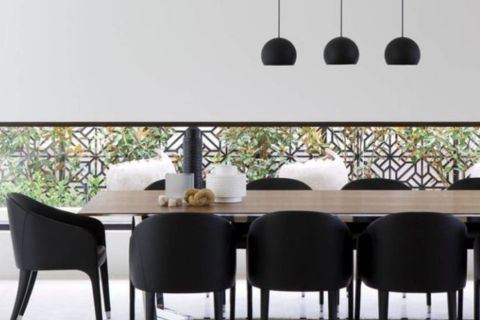

What is the standard chandelier height above a dining table?
The standard chandelier height above a dining table is typically 30- 36 inches from the tabletop to the fixture’s lowest point in a room with an 8-foot ceiling.
Next, here’s why that range works in real homes: it keeps the chandelier low enough to “anchor” the table visually and deliver pleasant light, while staying high enough that it doesn’t block faces or feel intrusive during meals.
- Comfort: People can sit and stand without feeling like a fixture is hovering too close.
- Conversation: Most sightlines remain clear across the table.
- Style: The chandelier looks intentionally placed, not accidentally too high.
A quick note before you measure: this standard assumes a typical dining table height (often around the high-20s to ~30 inches). If your table is extra tall (counter-height dining) or unusually low, you’ll still use the same method just measure from your tabletop, not an assumed one.

Example: According to The Spruce, a common guideline is placing a dining chandelier about 30-36 inches above the table for both lighting performance and visual appeal.
Do you measure chandelier height from the ceiling or from the tabletop?
Yes measure from the tabletop if your goal is correct clearance. The most useful measurement is the vertical distance from the tabletop to the lowest point of the chandelier (the bottom edge of the fixture, not the canopy on the ceiling).
Next, use the ceiling measurement only for installation math like chain length, downrod selection, and whether your chandelier will look proportionate in the room.
A quick measuring checklist
- Find the tabletop height (floor to tabletop).
- Choose a target clearance (start with 30–36 inches above tabletop for 8-foot ceilings).
- Identify the “lowest point” (often the bottom finial or lowest crystal).
- Mark the drop using painter’s tape on a nearby wall or a temporary hook (more on this in the sightlines section).

How do you adjust chandelier height for different ceiling heights?
Adjust chandelier height by starting with the standard 30–36 inches above the tabletop for 8-foot ceilings, then raising the chandelier about 3 inches for each additional foot of ceiling height.
Next, think of this as a “proportion rule.” Taller ceilings need a slightly higher drop so the fixture doesn’t dominate the table or feel too close in the larger vertical space.
Video show you how hight to hang chandelier
What height works for an 8-foot ceiling?
For an 8-foot ceiling, keep the chandelier’s lowest point roughly 30-36 inches above the tabletop.
If your chandelier is visually large or has a busy silhouette, lean toward the higher end of that range so sightlines stay comfortable.
How high should it hang with 9–10-foot ceilings?
With 9-foot ceilings, a common adjustment is to raise the chandelier to about 33-39 inches above the tabletop (adding ~3 inches).
For 10-foot ceilings, many installers add another ~3 inches and then confirm with a sightline test so it still feels connected to the table.
What changes with vaulted or very high ceilings?
Vaulted or very high ceilings often require you to balance two goals: keeping the chandelier visually “anchored” to the table while also scaling it to the room.
The safest approach is to keep your tabletop clearance comfortable (often still in the 30s range) and choose a fixture with enough visual presence or use a longer drop so it doesn’t look undersized for the volume of space.

Evidence example: The Spruce notes the standard 30–36 inch range and suggests raising the chandelier about 3 inches per additional foot when ceilings exceed 8 feet.
What chandelier height keeps the best sightlines (and avoids glare)?
The best chandelier height protects sightlines: people should be able to see each other comfortably across the table, and the fixture should not place bright bulbs directly in your line of sight when seated.
Next, use a simple rule: if the chandelier blocks faces or the bulbs feel glaring at eye level, raise it slightly or reduce glare with diffusers, shades, and dimming.
How do you test sightlines before final installation?
The easiest sightline test is a “real life” test not a math-only test. To do it:
- Sit at the table in your usual dining chair position.
- Have someone hold the chandelier (or a cardboard template) at the planned height.
- Check face-to-face visibility from multiple seats.
- Stand up and walk around the table to confirm it doesn’t feel too low.
If you’re working solo, hang a temporary hook and suspend a weighted string to represent the chandelier’s lowest point, then adjust until the view feels natural.
How do you reduce glare if the chandelier must hang higher/lower?
If you can’t move the chandelier much because of wiring placement or a fixed chain, glare control becomes the smart workaround. Specifically:
- Use a dimmer so you can soften brightness during dinner.
- Choose diffused bulbs (frosted instead of clear) to reduce harsh points of light.
- Pick shaded designs or add bulb sleeves/candle covers where appropriate.
- Aim for warm, comfortable light rather than high-glare, high-output bulbs at eye level.

How do you choose the right chandelier size for your table?
Choose chandelier size by matching the fixture’s width to the table’s width, leaving enough margin so it doesn’t overpower the seating area. A common proportion guideline for pendants over tables is sizing the diameter to roughly one-third to one-half of the table width for balance.
Next, remember that size and height work together: a very large chandelier can often hang a bit higher (within reason) without feeling disconnected, while a small fixture hung too high can look lost.
What chandelier size works for a rectangular dining table?
For rectangular tables, you usually have two strong paths:
- A linear chandelier that echoes the table shape and spreads light evenly across the length.
- A multi-light chandelier (or a cluster) that visually fills the center while still covering the table.
The key is coverage: you want light across the center of the tabletop, not only in the middle with dark ends.
What chandelier size works for a round table?
Round tables usually look best with a round chandelier, globe, or a compact multi-light fixture.
The goal is symmetry: a centered fixture with a diameter that feels proportional to the tabletop and that doesn’t extend so wide it competes with chairs.

Which is better over a dining table: a chandelier or multiple pendant lights?
A chandelier usually wins for a unified, statement look, while multiple pendants are often better for long tables where you want evenly distributed pools of light.
Next, decide based on your table shape, room scale, and how you use the dining space:
- Choose a chandelier if you want one centered focal point and a cohesive silhouette.
- Choose multiple pendants if your table is long and you want consistent light coverage end-to-end.
- Choose a linear chandelier if you like the “one fixture” look but need long-table coverage.
If you go with multiple pendants, keep the hanging heights consistent so the group looks intentional and space them so each pendant contributes to even lighting rather than creating bright spots and shadows.
(As a reference, Louis Poulsen suggests multiple pendants for longer tables and discusses spacing for balanced illumination.)

How do you position the chandelier over the table (center, length, and alignment)?
Position the chandelier by centering it over the table not the room. The chandelier should align with the tabletop’s centerline so the light feels anchored to dining, even in open layouts where the table isn’t perfectly centered in the space.
Next, use these practical alignment rules:
- Center on the table’s midpoint: measure the table length and width, then find the exact center.
- Keep the fixture visually inside the table zone: avoid designs that extend far beyond the table edges.
- Align with chairs and walkways: make sure the chandelier doesn’t feel like it’s hanging over a traffic lane.
If you have an extendable table
If your table has leaves, decide whether you want the chandelier centered for everyday use or for the fully extended size. Many homeowners center it for daily life, then rely on dimming and candles/auxiliary lighting for large gatherings.
What are the most common chandelier height mistakes and how do you fix them?
The most common chandelier height mistakes are hanging it too high, too low, choosing the wrong size, or placing it off-center each of which can make the table feel awkward, dim, or visually “off.”
Next, use this quick troubleshooting guide to fix problems without starting over.
Mistake 1: Hanging it too high
- What it feels like: the chandelier looks disconnected; the table feels under-lit.
- Fix: lower the fixture toward the standard range, or increase brightness with additional lamps (and add a dimmer for control).
Mistake 2: Hanging it too low
- What it feels like: blocked sightlines, a “ceiling dropping” sensation, and glare at eye level.
- Fix: raise it slightly, switch to diffused bulbs, and confirm with a seated sightline test.
Mistake 3: Choosing a fixture that’s too small
- What it feels like: the chandelier gets lost in the room, especially with higher ceilings.
- Fix: choose a wider fixture or a multi-light/linear design that better matches table scale.
Mistake 4: Off-center placement
- What it feels like: everything looks slightly wrong even if the chandelier is “pretty.”
- Fix: re-center over the table (often easiest during a fixture upgrade), or visually correct with a swag hook when appropriate.
What special cases change chandelier height (vaulted ceilings, extension tables, and open layouts)?
Special cases change chandelier height when the room’s geometry or use breaks the “standard dining room” assumption like vaulted ceilings, sloped ceilings, extension tables, or open-concept layouts where the table isn’t centered. In these scenarios, you still start with a comfortable tabletop clearance, then adjust for proportion and function.
Next, use the correct “antonym thinking” to solve edge cases: high vs low (proportion), bright vs glare (comfort), centered vs off-center (visual logic), and small vs oversized (scale).
How do you hang a chandelier over an extendable dining table?
Over an extendable table, you have two good strategies:
(1) center for everyday use and rely on dimming/secondary lighting for big gatherings, or
(2) center for the extended position if you host large dinners frequently.
If the chandelier must stay where it is, a linear fixture can visually “stretch” with the table better than a compact round chandelier.
What height works in open-concept dining spaces?
In open-concept layouts, your chandelier often becomes a “zone marker.” Keep the fixture centered over the table and use height to maintain clear views across dining into the adjacent kitchen/living area.
If the chandelier feels like it’s competing with nearby pendants or recessed lights, choose a slightly simpler silhouette and rely on dimming for mood control.
How do you handle sloped or vaulted ceilings safely?
For sloped or vaulted ceilings, the “safe” path is using a compatible mount or adapter designed for angled ceilings, then setting the chandelier drop so it hangs straight and remains centered over the table.
After that, confirm the final height with the same seated sightline test because angled ceilings can trick your eye and make a fixture look higher or lower than it is.
Do chandelier height rules change for kitchen islands vs dining tables?
Yes slightly. Islands often prioritize task lighting for prep work, while dining tables prioritize comfort lighting for conversation and ambiance.
The baseline height range can overlap, but islands may use brighter, more focused light and sometimes a slightly different placement strategy to avoid shadows on work surfaces.
(Studio McGee’s hanging height guide discusses the 30–36 inch starting point over surfaces and a “add inches per extra ceiling foot” approach in kitchen contexts.)
Final takeaway: Set your chandelier height above the table with a reliable baseline (often 30-36 inches above the tabletop for standard ceilings), then adjust for ceiling height and confirm with a seated sightline test so conversation stays clear and glare stays low.
Source:
- https://i.pinimg.com/736x/d5/fb/79/d5fb7997f5de701e4c257a2a881a582f.jpg
- https://i.pinimg.com/474x/c5/1f/29/c51f29d1aaa1c982de5f98f15da37f9c.jpg
- https://i.pinimg.com/564x/fc/8a/4b/fc8a4bb591b043cfc409e7940a6a60b2.jpg
- https://i.pinimg.com/474x/75/86/49/7586491da71d8e1957bc25ce634ea159.jpg
- https://i.pinimg.com/564x/ab/d5/48/abd548404ad1369bc8f15964d2cda823.jpg
- https://i.pinimg.com/564x/4f/b6/25/4fb6250e4c3bdcbcb43b9500ea93ff3d.jpg
- https://i.pinimg.com/474x/9d/80/6a/9d806afcf79e771a4b4c93f07c39e4ca.jpg
Articles on the same topic:
-

What Size Pendant Light for Living Room? Dimensions Height Guide
-

Outdoor Covered Patio Lighting Ideas That Actually Work
-

How to Remove a Fluorescent Light Cover (Lens) Safely: Tabs, Clips, and Sliding Diffusers
-

How Many Pendant Lights Over a 5 Foot Island? The Definitive Spacing & Sizing Guide
-
How to Add Lighting to a Room Without Wiring With 10 Smart Solutions
-
What Is Scandinavian Design and What Makes This Style So Distinctive