
Stepping into a room where the artwork is placed perfectly creates an instant sense of visual comfort. By mastering the art hanging height rule, specifically the 60-inch center rule, you can elevate your space from amateur to professional gallery standards effortlessly.
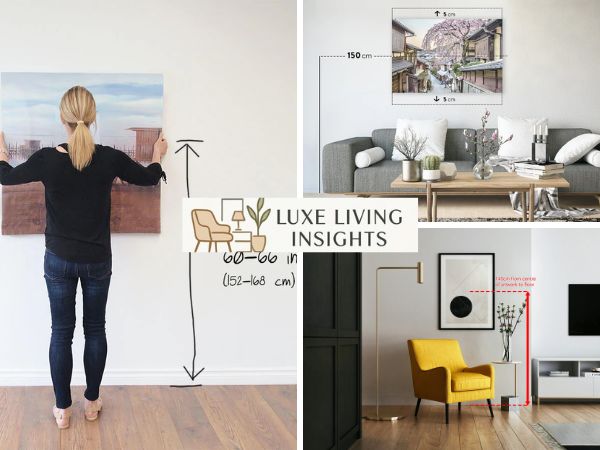
How to Use the Art Hanging Height Rule (57-Inch Rule Explained)
This is the most common guideline for how high to hang pictures in any room.
The most common mistake in home decor is hanging artwork too high. You shouldn’t have to crane your neck to appreciate a beautiful canvas.
Instead, we look to art galleries and museum standards for the 57-inch rule. This standard gallery height ensures that the center of the piece aligns with the average eye-level, creating a focal point that feels natural and grounded.
To execute this, you need a tape measure, a pencil, and a level tool. First, find the center point of your picture frame by taking the height divided by 2. Then, measure 57 to 60 inches up from the floor—your reference point—and make a light mark.
However, you cannot simply put the nail there. You must calculate the wire drop. Measure the distance from the top of the frame to the taut hanging wire. Subtract this distance from your 57-inch mark to find the exact mounting height.
For those with high ceilings, you might feel the urge to go higher. Resist it. While you can make slight adjustments up to 60 inches, keeping the center of gravity near the 57-inch mark ensures visual weight is distributed correctly across the vertical wall sections.
If you are also updating your fixtures, you might find our ultimate guide to kitchen & dining lighting helpful for coordinating heights.
Quick steps:
-
Measure artwork height and divide by 2
-
Mark 57–60 inches from the floor
-
Subtract the wire drop
-
Place your nail at the final point
Bridging the Gap: Art hanging height rule Above Furniture Without the Floating Effect
When artwork occupies wall space above a sofa, dresser, or console table, the eye-level rule changes. Here, the furniture acts as an anchor. If you hang the art too high, it creates a disjointed look known as the floating effect. To prevent a floating effect, the bottom of the frame should have a top clearance of 4–8 inches from the furniture.
Proportion is equally vital. Your art piece or grouping should maintain a width ratio of 1/2 to 2/3 of the furniture width. If a piece is too small, it loses its visual connection.

If you have a large canvas, it should serve as a focal point that feels heavy enough to balance the sofa below. Using painter’s tape to simulate frame placement before hammering anchors and screws into the drywall is a pro tip that saves your walls from unnecessary holes.
| Entity | Attribute | Value |
|---|---|---|
| Artwork | Mounting Height | 57-60 inches |
| Furniture | Top Clearance | 4-8 inches |
| Art Piece | Width Ratio | 2/3 of furniture width |
| Floor | Reference Point | Base zero |
Designing a Cohesive Gallery Wall or Multi-Piece Display
A gallery wall can easily become cluttered if not approached with spatial awareness. The trick is to treat the entire grouping as one piece. This means the collective center of the grouping should sit at the standard height of 57 inches off the floor.
Consistent spacing is the secret to grouping cohesion. You should group closely, keeping 2–3 inches between decorative frames. If the spacing exceeds this, the visual connection breaks, and the wall looks messy.
Whether you prefer modern organic, Japandi, or wabi-sabi aesthetics, symmetry and balance remain the core pillars of a successful gallery wall.
Mastering Scale: Choosing the Right Size for Your Wall Space
Scale defines proportion in a room. Many homeowners choose pieces that are too small, leading to a dinky appearance. Bigger is better when it comes to wall art.
A large-scale piece fills the wall and provides visual balance. If you only have small pieces, grouping them together allows them to act as one unified piece, taking up the necessary visual weight.

Before the final installation, have someone hold the piece while you take a picture. Looking at the aspect ratio through a lens provides fresh eyes and helps you decide if the piece really works for the spatial layout of the room. If you are bringing in large new items, ensure you know how to measure furniture for stairs to avoid delivery headaches.
Navigating Structural Challenges and Architectural Exceptions
Sometimes residential architecture gets in the way. A chair rail or complex wall studs can interrupt the 57-inch rule. If a chair rail is present, avoid letting the frame hang directly over it. Instead, adjust slightly to hang the bottom of the picture about 2–3 inches above the rail. This maintains visual comfort while respecting the architectural lines of the home.
Essential Tools and Final Installation Tips
A successful project requires the right mounting hardware. Beyond the measuring tape, use a level tool to ensure every frame is perfectly horizontal. If you are renting, Command Strips are a great alternative to wall studs and screws.
Always step back to check the visual balance from across the room. For those creating a gallery feel with lighting, consider rattan ceiling pendant ideas for boho & coastal rooms to complement your artwork.
Frequently Asked Questions
What is the 57-inch rule for hanging art
The 57-inch rule is a museum standard where the center of the artwork is positioned exactly 57 inches from the floor. This height mimics average eye-level, providing the most visual comfort for viewers. It is the center point, not the top of the frame, that should align with this measurement.
How high should I hang a picture over a sofa
When hanging art above furniture, the bottom of the frame should be 4 to 8 inches above the top of the sofa or console table. This top clearance ensures a visual connection between the artwork and the furniture, preventing the art from looking like it is floating too high on the wall.
What should the width of the art be compared to the furniture
To master scale, the artwork or grouping should span 1/2 to 2/3 of the furniture width. If the art piece is narrower than half the width of the sofa or bed, it will likely appear too small and lose its visual role as a focal point.
How do I calculate the spot for the nail
First, measure your artwork’s height and divide by 2 to find the center. Mark 57 inches on the wall. Then, measure the wire drop—the distance from the top of the frame to the taut hanging wire. Subtract this distance from your 57-inch mark to find the exact spot to hammer your anchors and screws.
Conclusion
Correct art hanging height rule visual balance and room polish. We hope this guide helps you hang your art with confidence. Please share your thoughts or leave a comment below. For more expert interior design tips, visit luxelivinginsights.com.