
Mastering how to measure room for furniture is the essential first step in creating a home you love. This guide covers step-by-step processes, traffic flow, and delivery paths to ensure every furniture footprint fits your floor plan perfectly. Whether you are looking at stunning luxury sofa designs for your living space or simple accents, accuracy is your best friend. Start your interior journey with confidence today!

Quick Answer: How to Measure a Room for Furniture
- Measure wall-to-wall length and width
- Note ceiling height and window placement
- Leave 30–36 inches for walkways
- Check doorways, hallways, and stairs for delivery
- Use painter’s tape to map furniture size on the floor
This quick check prevents 90% of furniture fitting problems.
How to measure room for furniture (Step-by-Step Guide)
Finding the perfect piece of furniture is a thrill. However, the excitement can turn into a nightmare if that new sofa does not fit. You need a solid plan.
Think of it like gathering ingredients before you start cooking. Having everything ready makes the whole process smooth. You do not need a contractor’s toolkit. Just a few everyday items will give you the numbers you need.
To start, you need the right tools. A tape measure length of 25 feet is ideal. It is stiff enough to measure ceiling height without sagging. You also need a notepad and a pencil. These are tools that assist accurate measuring. While a laser distance meter is a neat gadget, it is not a must-have. Your classic tape measure is more than enough.
First, you must create a floor plan sketching of your space. This sketch records room dimensions. Draw a rough outline of the room. Note where the doors, windows, and outlets are. This visual map is a blueprint for your success.
Start by measuring the main walls. Use the clockwise measuring technique to ensure you do not miss anything. Run your tape from one corner to the other. In older homes, walls are rarely straight. Measure at three different heights. Always use the smallest number. This gives you a worst-case-scenario number.

Next, focus on architectural obstacles. These are the fixed elements you must work around. Measure every window and doorway. Include the frame in your numbers. Note the window sill height at 24 inches and the outlet position at 12 inches from the floor.
These obstacles influence furniture layout. You do not want to block a power source. Note the radiator depth of 6 inches and how far it sticks out.
Measurements guide interior design by defining the usable area. Understanding the room perimeter and wall surface materials like plaster or drywall ensures your measurements stay honest and reliable.
Don’t forget to look up. Ceiling height is critical. A ceiling height of 8 feet might feel standard, but it constrains cabinet height. Measure from the floor to the ceiling in several spots.
This number is your best friend when buying a tall bookcase or headboard. Getting these vertical measurements right is a total game-changer. It ensures that the scale maintains proportional design and prevents the room from feeling cramped.
| Entity | Attribute | Value |
|---|---|---|
| Room | Length | Inches |
| Tape Measure | Length | 25 feet |
| Ceiling | Height | 8 feet |
| Floor Plan | Scale | 1/4 inch |
| Corner | Angle | 90 degrees |
Accounting for Furniture Clearance and Traffic Flow
A room can have beautiful furniture and still feel cramped. This happens when you ignore traffic flow. A room only functions well if there is enough negative space. This is the invisible area your family uses every day. You want paths to be clear.
No one should have to shimmy sideways past a table. Traffic flow defines walkways and ensures comfort. Walkways ensure easy movement throughout the home, preventing common frustrations.
The golden rule for a comfortable room is leaving enough space for major walkways. You should allow a walkway clearance of 36 inches.
This gives everyone room to move without bumping into corners. For minor walkways, such as the space between a chair and a wall, you can use 24 inches. If you are integrating stunning oak furniture coffee tables for your living space, ensure they don’t block these vital circulation spaces.
Specific furniture pieces need their own breathing room. Keep your coffee table about 16 to 18 inches from the edge of your sofa. This is the sweet spot. It is close enough to set down a drink but far enough for legroom.
For a dining area, learning how to choose a dining table for your space is key; always leave at least 36 inches of dining table edge clearance. This lets guests pull out their chairs comfortably. Clearances prevent overcrowding and make a home feel inviting.
Remember the 2/3 rule. A sofa should take up about two-thirds of the wall it sits on. This creates visual balance. If the sofa is too small, it looks lost. If it is too big, the room feels stuffed. Proportions create visual balance in any interior design project.
Layout optimizes functional use. Always consider how rugs anchor furniture group items, ensuring the rug dimension fits the scale of the room.
Standard Furniture and Room Sizes (US Guide)
Here are some common dimensions to keep in mind:
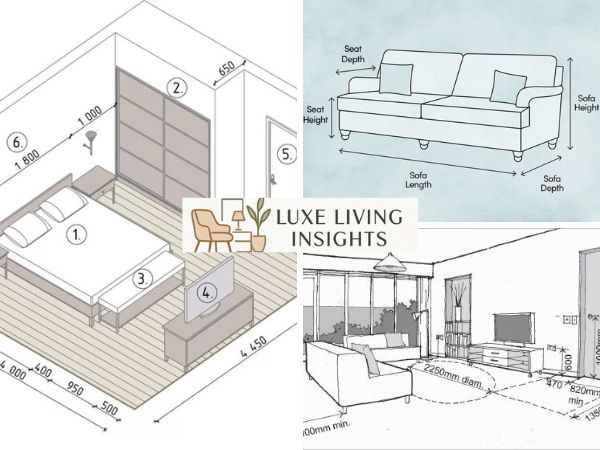
- Sofa: 72–96 inches wide
- Coffee table: 36–48 inches long
- Dining table: 60–72 inches for 4–6 people
- Walkway clearance: 30–36 inches
- Typical living room: 12 x 18 feet
These benchmarks help you quickly estimate what will fit your space.
Measuring the Delivery Path from Curb to Room
Measuring the room is only half the battle. You also have to measure the delivery path. This is the route from the delivery truck to the final spot.
Many people forget this step. A sofa might fit the room but not the front door. Doorways permit furniture entry, but they also act as filters. Doorway width of 32 inches is a common bottleneck. For detailed logistics, check out how to measure furniture for stairs to avoid getting stuck.
Start at your front entrance. Walk the exact path the furniture will take. Measure the width of every hallway and stairwell. Note the hallway minimum width of 30 inches. For stairs, check the staircase headroom of 80 inches.
Stairwells challenge delivery logistics, especially if there is a tight turn. Measure the landing depth and height. Can a long headboard pivot point function there? Handrails reduce stair width by several inches, so measure from the rail, not the wall.
If a straight measurement says a piece will not fit, use the diagonal measurement. Large, flat items are often tilted. Measure from the bottom corner of the doorway to the opposite top corner. An entryway diagonal of 40 inches might be the key.
Diagonal measurements verify corner clearance for bulky items. This simple trick has saved countless deliveries. Dimensions prevent return shipping costs and headaches. Delivery path includes hallways and every architectural obstruction along the way.
- User measures wall to find the perimeter and wall-to-wall measurement.
- Doorway limits access for large sectionals or armoires.
- Staircase connects floors but restricts total item length.
- Tape measure determines distance with mechanical precision.
Pro tip: Many furniture returns happen not because the item is too big for the room — but because it can’t get through the door.
Always measure your narrowest doorway before buying.
Planning for Specific Furniture Types and Features
Different furniture types interact with your room in unique ways. A sectional sofa requires careful space planning. You need to measure the overall length of each side. Measure from the back corner out to the end of each arm.
Also, check the sofa footprint of 84″ x 36″. Sofa requires clearance so it does not block traffic flow. Sketch this on your plan to see how it impacts the room’s symmetry and functional use.
If you love recliners, account for the full extension. A chair might need a recliner full extension of 65 inches. This means it needs significant forward and backward space. If you place it too close to a wall, it will hit the plaster or drywall.
Obstacles influence furniture layout, and movement is the biggest obstacle of all. Always account for desk chair push-back space of 36 to 48 inches in home offices.
Consider your rug dimension of 8′ x 10′ carefully. A rug anchors furniture group items together. It should be large enough so the front legs of the seating sit on it. Also, check window sill height. Windows provide natural light, and you do not want to block it with a tall dresser.
Window obstructs high furniture placement. Finally, ensure lighting requires outlet access. Do not hide your plugs behind a heavy armoire. Electrical outlets inform placement and overall real estate utility.
Visualizing the Layout Before You Buy
Before you spend money, visualize the fit. Use painter’s tape mapping to mark the furniture footprint on the floor. This lets you see the actual size in your space. Painter’s tape visualizes furniture placement without moving heavy objects.

Walk through the taped-off paths. Does the room still feel open? This method helps identify negative space issues before they become permanent.
You can also use household items as placeholders. Use boxes to simulate the bulk of a new sofa. This helps you feel the negative space. Once you are happy, finalize your scaled floor plan. Use a scale of 1/4 inch to represent one foot. This plan precedes furniture purchase. It gives you the confidence to say yes to the one.
Floor plans facilitate space planning for both small apartments and large homes. When you have the numbers, you are in control. You avoid the stress of “will it fit?” and focus on the joy of decorating. Accurate dimensions are the foundation of a beautiful, functional home.
By recording corner-to-corner distance and standard furniture sizes, you bridge the gap between architecture and home improvement.
Frequently Asked Questions
What are the biggest mistakes people make when measuring?
The most common error is forgetting to measure the delivery path. Homeowners often map the room perfectly but overlook the narrow hallways or stairwells the furniture must travel through. Another frequent mistake is ignoring small architectural details like baseboards, radiators, and window sills, which can reduce the usable floor space by several inches. Finally, many people fail to measure vertical height, which is essential for tall pieces like bookcases or armoires.
How do I measure for an L-shaped sectional sofa?
Measuring for a sectional requires two primary dimensions: the overall length of each side. You must measure from the back corner out to the end of each arm. Additionally, you must measure the total depth of the sofa to ensure it does not obstruct major walkways. It is highly recommended to sketch the sofa footprint on your floor plan to visualize how the piece will define the traffic flow of the room.
Should I round my measurements up or down?
When measuring the room itself, you should be as precise as possible. If a wall is uneven, always use the smallest measurement obtained. However, when selecting furniture, you should round up to give yourself breathing room. It is advisable to leave a clearance of 2 to 3 inches on each side of large items. This prevents the space from looking overstuffed and allows for easier cleaning and maintenance.
Conclusion
Measuring accurately is the first step to a beautiful home. For more expert interior tips, visit luxelivinginsights.com. Please share your how to measure room for furniture or leave a comment below to help others in our community!